Listing Photos for Out-of-State Buyers: What the DC Metro Area’s Relocation Market Needs to See
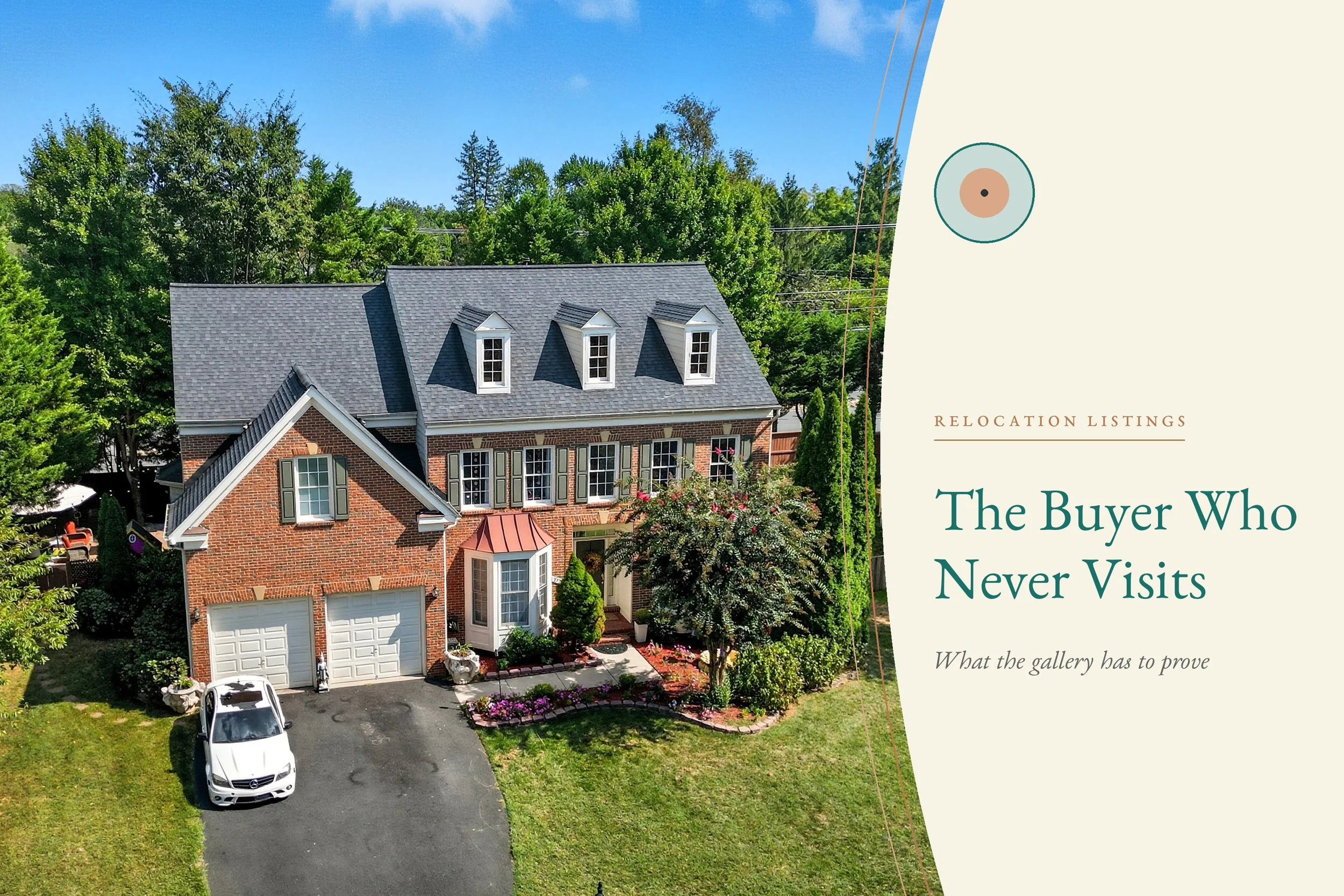
A buyer in San Diego has forty minutes between meetings, a phone, and a listing that went active this morning in Vienna. They will not be walking through it this weekend, or next. If the photos do their job, they will ask their agent to write an offer on a house they have never stood inside.
That is an ordinary transaction in this region. The DC Metro Area runs on arrivals. A PCS cycle moves families to Fort Belvoir, Quantico, Fort Meade and Joint Base Andrews on the military's calendar rather than the market's. Federal hires and agency transfers come with start dates set months before anyone gets house-hunting leave. Contractors whose clearance has come through need an address inside a commutable ring, and embassy and university postings begin on a fixed date. These buyers are not browsing. They are deciding, on a deadline, from somewhere else.
A listing gallery shot for a local buyer assumes a showing is coming. A gallery shot for a relocating buyer has to do the showing's work. Those are different jobs, and the difference is not a longer shot list — it is what the photos are being asked to prove.
1. What the gallery has to replace
A buyer who visits a house collects a great deal without noticing. They see how far the front door sits from the street. They register the ceiling height on the way in, the sound of the road, the light in the back rooms at four in the afternoon, whether the basement smells like a basement. None of it is written down. All of it goes into the decision.
Take the visit away and every one of those inputs has to come from somewhere else — the photos, the floor plan, the video, or a friend of a friend who agrees to drive by. The gallery is the only one of those the listing agent controls completely.
So the useful question when shooting for this buyer is not "does this room look good." It is "what would this buyer have learned by standing here, and does the frame carry it." A photo can be attractive and still answer nothing.
2. Where the house actually sits
The first thing a remote buyer cannot do is drive by. They cannot see that the house backs to trees rather than a parking lot, that the street is a cul-de-sac rather than a cut-through, that the lot rises from the road, or that the neighbor's addition looms over the side yard.
An elevated or aerial frame answers all of that, and there are two useful heights doing two different jobs. The first sits just above the roofline: high enough to clear parked cars and power lines and to show the lot, the setback and the landscaping, low enough that the house is unmistakably the subject. That is the frame that leads a gallery. The second is considerably higher, where the individual house gives up some prominence and the neighborhood arrives — the street pattern, the size of the lots, what backs onto the property and what sits across the road.
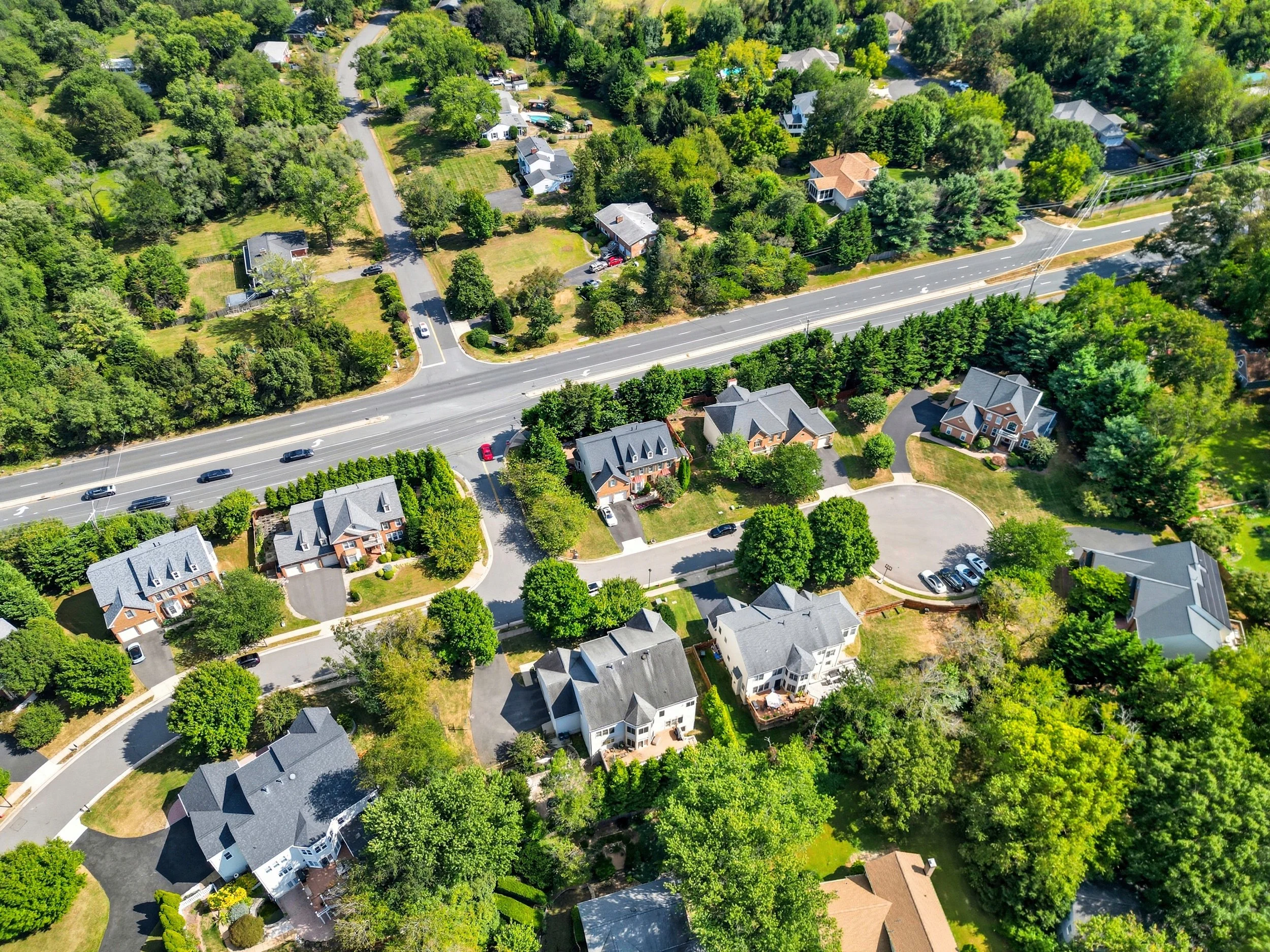
The higher frame — what a buyer would have picked up driving the street: the pattern of the lots, and what backs onto them.
Whether that frame comes from a drone depends on the address. Much of the region sits under layered federal airspace restrictions, and inside the innermost ring drone flight is prohibited without specific FAA authorization — which is why an elevated mast or an upper-floor vantage does this work for a great many DC addresses. Cove Media's breakdown of where flight is and is not permitted is in Drone Real Estate Photography in the DC Metro Area.
Context does not stop at the property line. For a buyer who has never been to Falls Church, a handful of frames of the walkable stretch of Broad Street, the Metro entrance, or the trail access at the end of the street answers a question the interior photos cannot. Cove Media sells this as a Community Photos add-on — five to ten images of the surrounding area and nearby points of interest — and on a relocation listing it is often the most-studied part of the gallery.
3. Scale is what photos get wrong
The complaint that follows a sight-unseen purchase is almost never about style. It is about size. The primary bedroom that looked generous is generous only if the bed goes on the one wall without a door or a window. The kitchen that read as open turns out to be open to a dining area the size of a rug.
Wide lenses are the reason. A very wide frame makes a room look larger and pushes the far wall away, and used carelessly it produces a photo that is accurate in content and misleading in feeling. A buyer who drives to the house discovers the gap in ninety seconds and adjusts. A buyer who flies in after closing does not get the chance.
Shooting for this buyer means keeping the focal length honest and letting the room be its size, framing from a corner so two walls establish proportion rather than one flat plane, and including a doorway or a piece of ordinary furniture in frame so the eye has a reference. A photo that makes an average bedroom look average is doing its job.
The other half of the answer is a floor plan, which converts every room into a number and takes the argument out of it entirely. Cove Media includes a basic 2D floor plan free with every shoot; the premium version, with square footage and fixed furniture, is $85, and a 3D version is $135. On a listing being sold to someone who cannot visit, that free scan is the single highest-value thing in the delivery. Cove Media's fuller argument for them is in Real Estate Floor Plans for DC Metro Listings.
4. A gallery a stranger can walk through
A local buyer uses the photos as a preview of a visit. A remote buyer uses them to build a map of a house they will not see, and a map only works if the pieces connect.
That puts weight on something most galleries never get tested on: whether the frames belong to each other. Shot across one visit, matched in exposure and white balance, and sequenced the way a person actually moves through the house, a set lets a stranger assemble a floor plan in their head. Shot piecemeal — the kitchen warm, the living room blue, the bedroom from a different height on a different day — the same rooms stay a pile of unrelated pictures, and the buyer never gets past evaluating them one at a time.
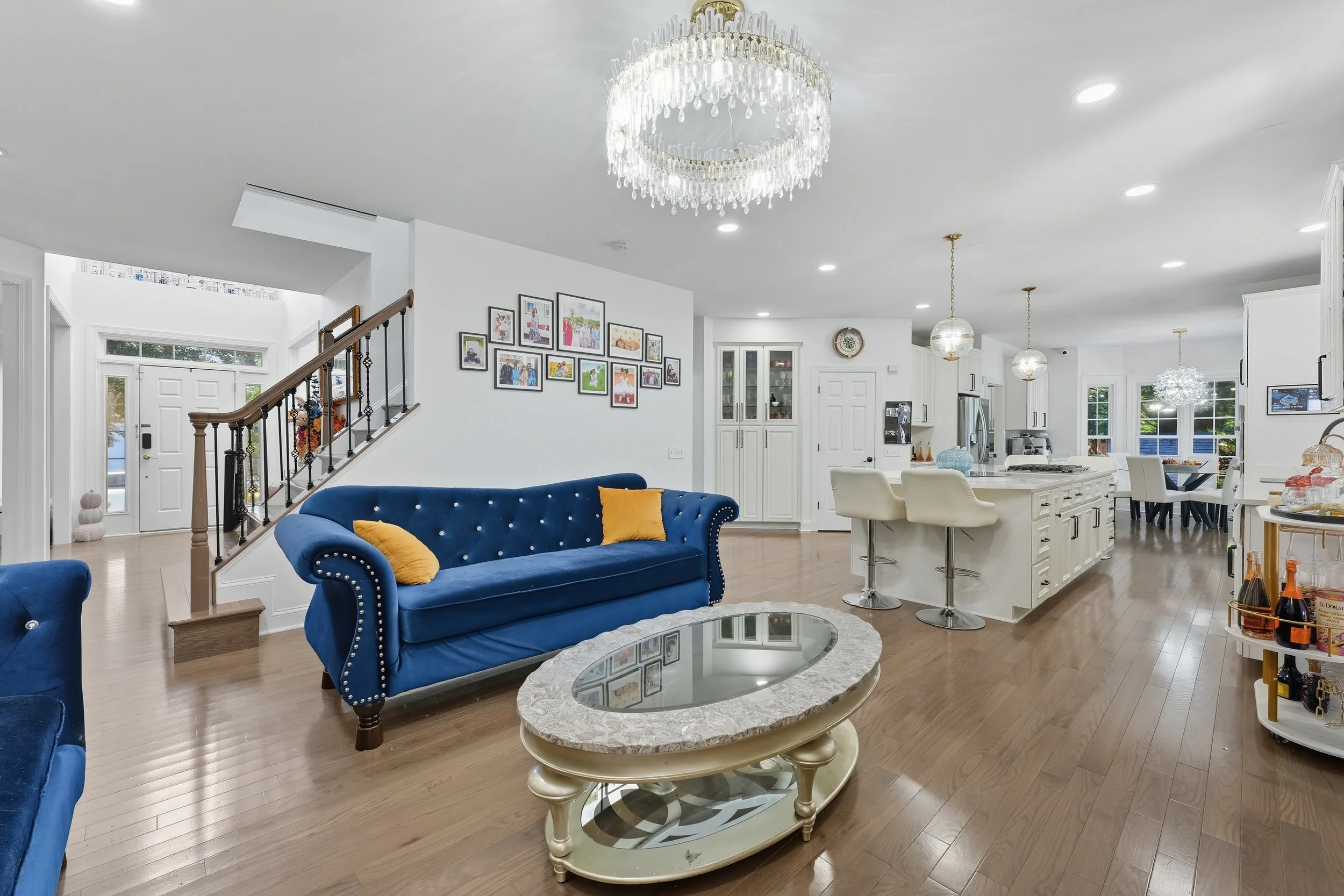
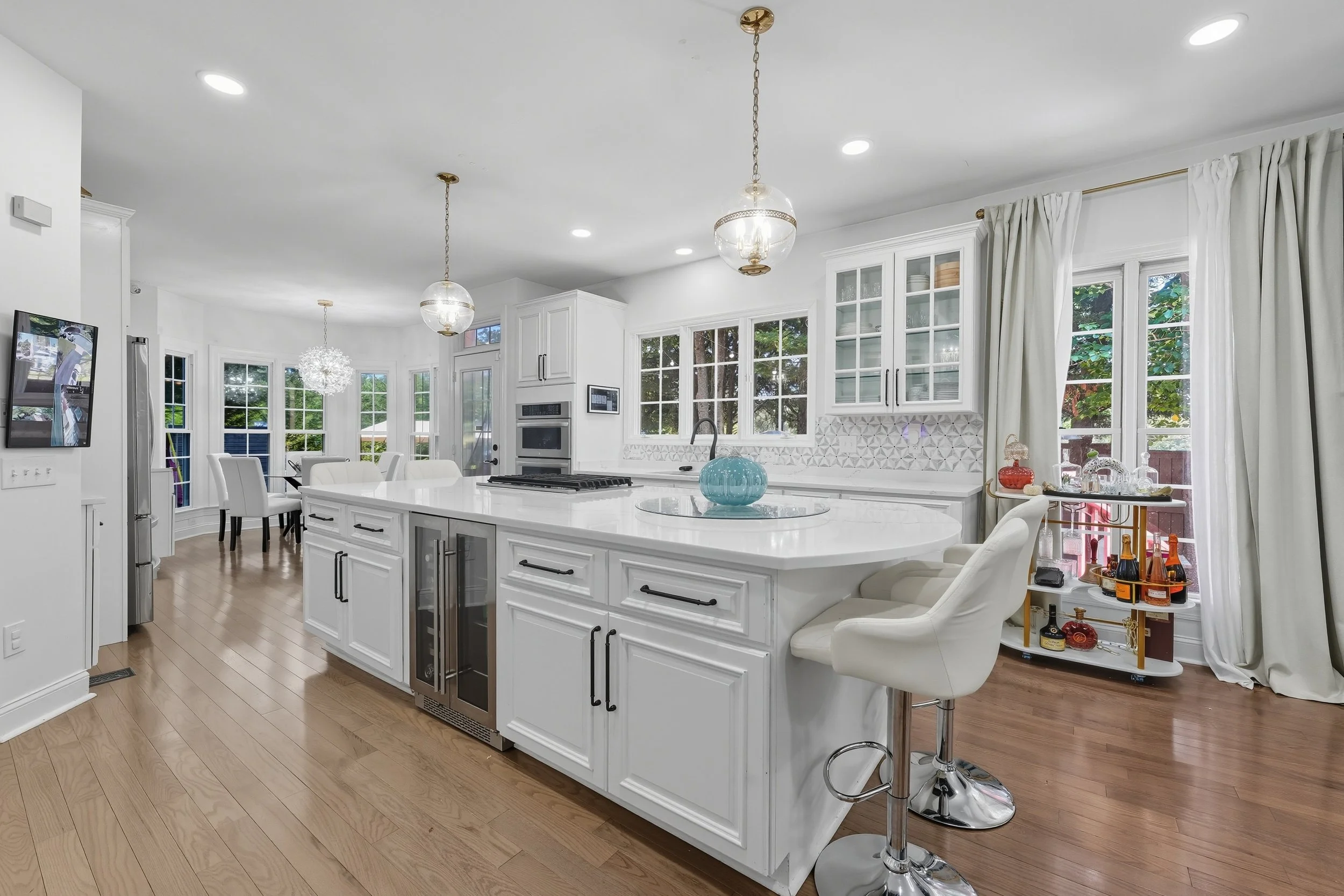
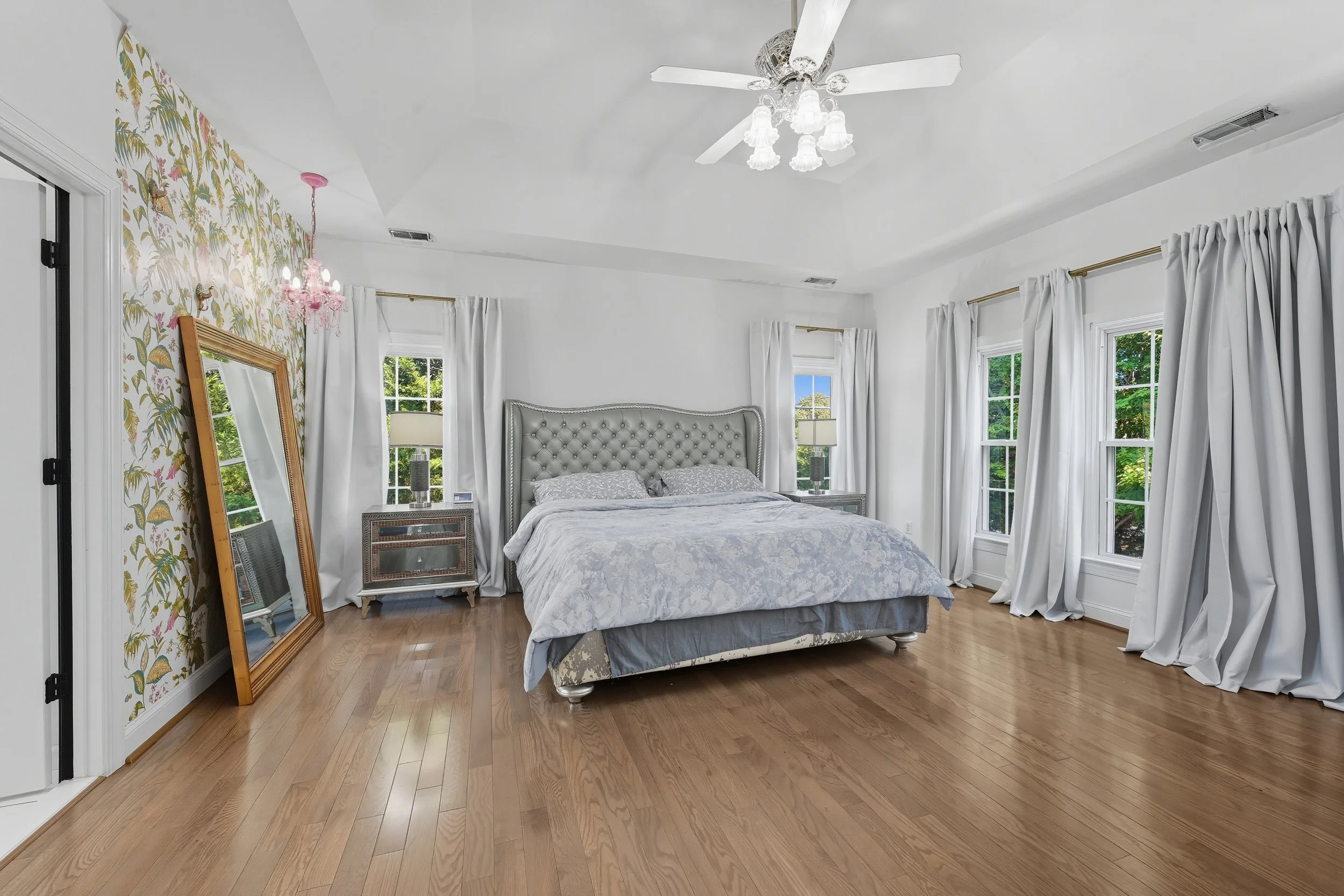
Four frames from one listing, in the order a visitor would meet them:
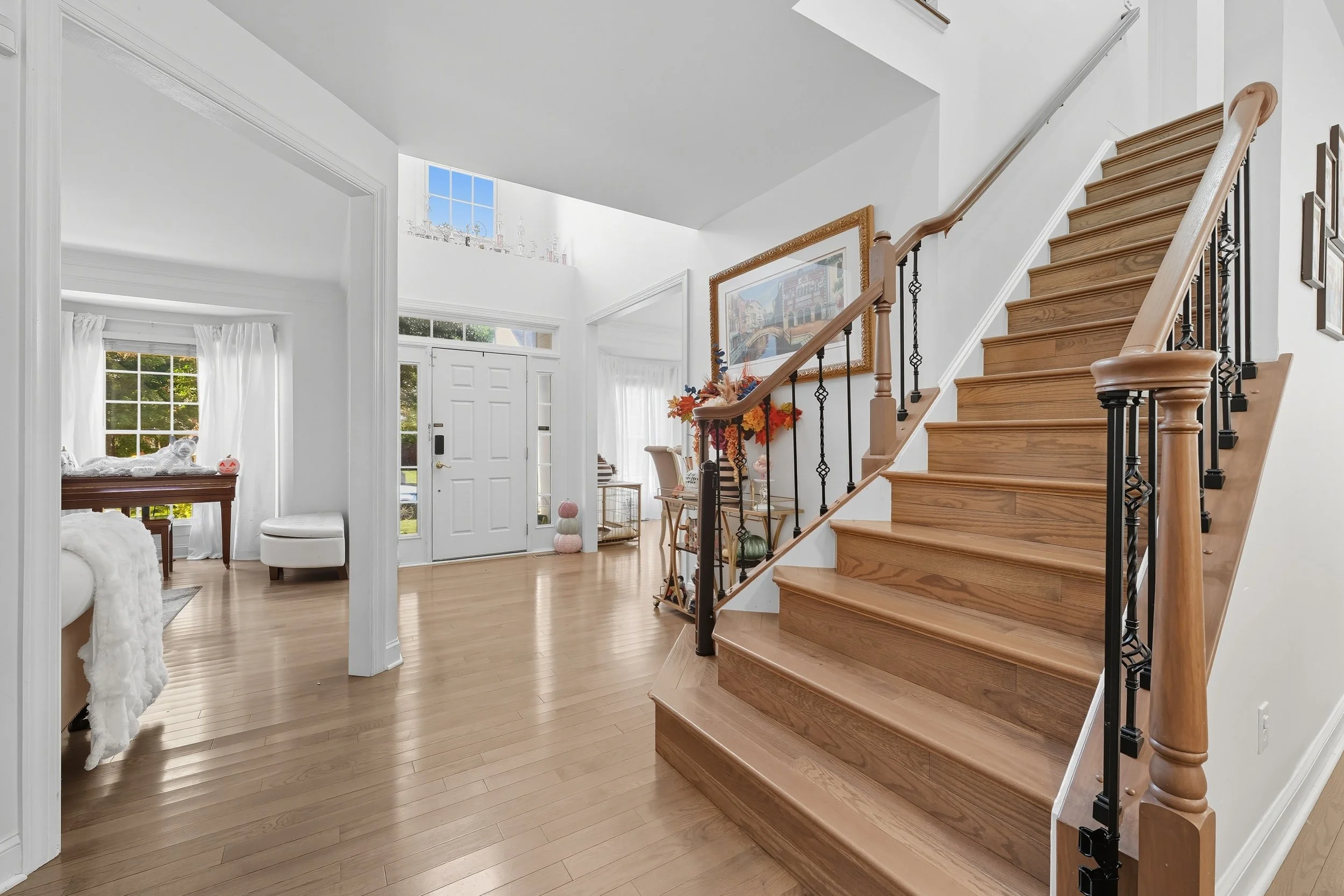
Foyer.
Living room.
Kitchen.
Primary bedroom.
The entry looks toward the staircase, the living room shows where that staircase lands, and the kitchen sits beyond it in the same frame. The floors are the same oak throughout, the whites are the same white, and every window is handled the same way. A buyer scrolling this set is not admiring four photographs. They are walking through a house.
The order carries as much as the matching. Exterior, entry, main living, kitchen, primary suite, secondary bedrooms, lower level, outdoor space, community. Cove Media's room-by-room breakdown of what belongs in each of those is in What Should Real Estate Photos Show?.
5. The rooms a remote buyer needs most
Every shot list has a tier that gets cut when the light goes or the schedule slips: the laundry room, the storage side of the basement, the garage, the utility closet, the second bathroom that nobody photographs well.
For a local buyer, cutting those is defensible. They will see the house. For a relocating buyer, those rooms are exactly the ones generating unanswered questions, because they are where the practical objections live. Is there a place for the washer and dryer on the bedroom level or is it a trip to the basement. Does the garage hold two cars or two cars and nothing else. Is the lower level finished, and finished how. Is there anywhere to put the things that do not fit in the rooms that photograph well.
A buyer who cannot resolve those questions from the gallery does one of two things: they ask their agent to go and look, which costs days, or they move on to a listing where the answers are visible. Neither is what the seller hired anyone for.
The rule inverts for this buyer. The rooms that look worst in photographs are the ones most worth including.
6. What stands in for the second showing
Photographs are a still medium and a house is not. There is a category of question — how the rooms connect, how long the hallway really is, what you see turning the corner — that a gallery answers slowly and a moving image answers at once.
That is what the walkthrough formats are for, and on a relocation listing they earn their cost more clearly than on any other. A 3D virtual tour lets a buyer click through the house in their own order and go back to the room they are unsure about. Cove Media shoots these on an 8K 360 camera, with Matterport and Zillow 3D both available; the fuller case for them is in Matterport 3D Virtual Tours for Real Estate in DC Metro. A cinematic walkthrough video does something different — it moves through the house on a fixed path with a point of view, which is closer to being walked around by an agent. The tour is $245 and the cinematic walkthrough $345, and both come at a reduced rate when they are booked as part of a package rather than added afterward.
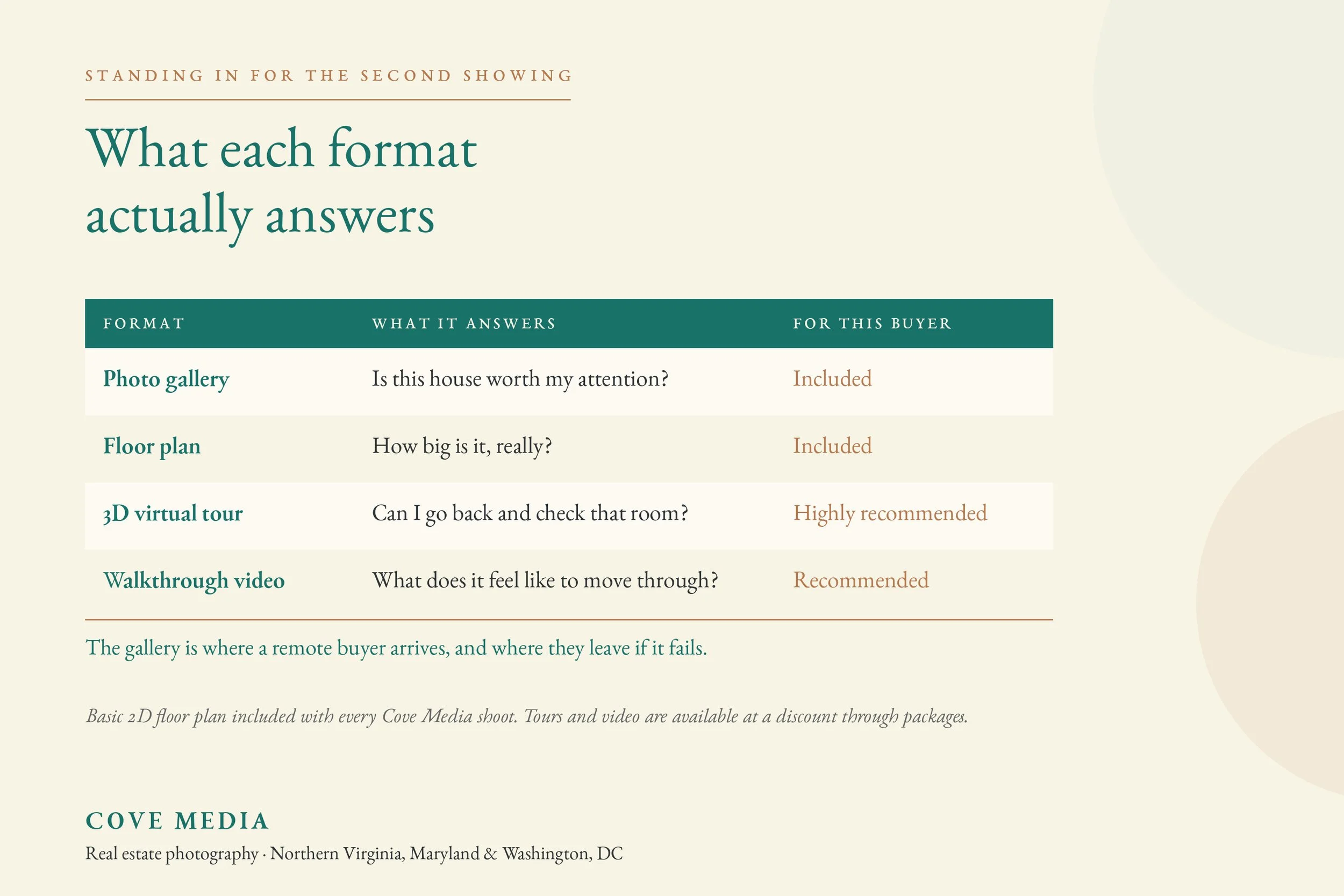
None of these replaces the gallery. A buyer arrives at the photos first and leaves if the photos fail. The tours and the video keep a buyer who is already interested from stalling at the point where they would otherwise have booked a showing.
7. The line between flattering and misleading
Every listing photograph is edited. Color correction, contrast and lens correction are routine, and no buyer is surprised by them. The category that matters for a buyer who cannot visit is a different one: edits that change what the photograph says is in the house.
Virtual staging puts furniture into an empty room. Item removal takes things out of a full one. A buyer standing in the doorway resolves both in a second. A buyer two thousand miles away has no way to.
Bright MLS requires the disclosure: virtually staged photos must be disclosed in the MLS. The rule does not name a field, so the public remarks — where a buyer's agent will actually read it — is the sensible place for it. That is a low bar and worth clearing carefully, because the failure mode on a relocation sale is not an awkward showing. It is a buyer who finds out late, after the inspection or after closing, and who then has a grievance rather than a question.
The self-interested version of the argument is simpler still. A relocating buyer who feels misled does not negotiate. They walk, and they do it late, after the listing has been off the market for two weeks. Photographs that describe a house accurately are the cheapest insurance available on a sight-unseen sale.
8. What this changes about the shoot
Shooting for a buyer who cannot visit does not require a different photographer or a longer day. It requires a few decisions made deliberately rather than by default.
Get the context frame. An elevated exterior, and community photos where the neighborhood is doing part of the selling.
Hold the focal length honest. A room that looks its real size is worth more here than a room that looks big.
Deliver a floor plan. It answers the scale question permanently and it is free with the shoot.
Shoot the whole house in one visit. Matching and sequence are what let a stranger assemble the place in their head.
Include the unphotogenic rooms. They are where the unanswered questions are.
Add a walkthrough format where the price supports it. A 3D tour or a video keeps an interested remote buyer moving.
Label what was altered. The disclosure costs nothing and the alternative can cost the sale.
Cove Media photographs listings across Northern Virginia, Maryland and Washington DC, in sets of 20, 40 or 60 images, with a basic floor plan included on every shoot and community photos, 3D tours and walkthrough video available as add-ons. Current rates and package details are on the pricing page.