Where Listing Photos Go After Delivery: MLS, Portals, Social and Print in the DC Metro Area
A photographer delivers a folder. Within hours the same pictures are in the MLS, and soon after they are on the portals, a brokerage website, an Instagram grid, an open-house flyer and a sign rider. Every one of those destinations reshapes the image, and only one of them was what the photographer framed for.
Most of what goes wrong with listing photography happens after delivery, in distribution. The frame gets re-cropped by systems nobody at the shoot was thinking about, and the rights get stretched across parties nobody named in writing. Both problems are avoidable once an agent has seen them laid out.
1. One shoot, several different shapes
A listing photo is composed for a rectangle. Almost nothing downstream keeps that rectangle.
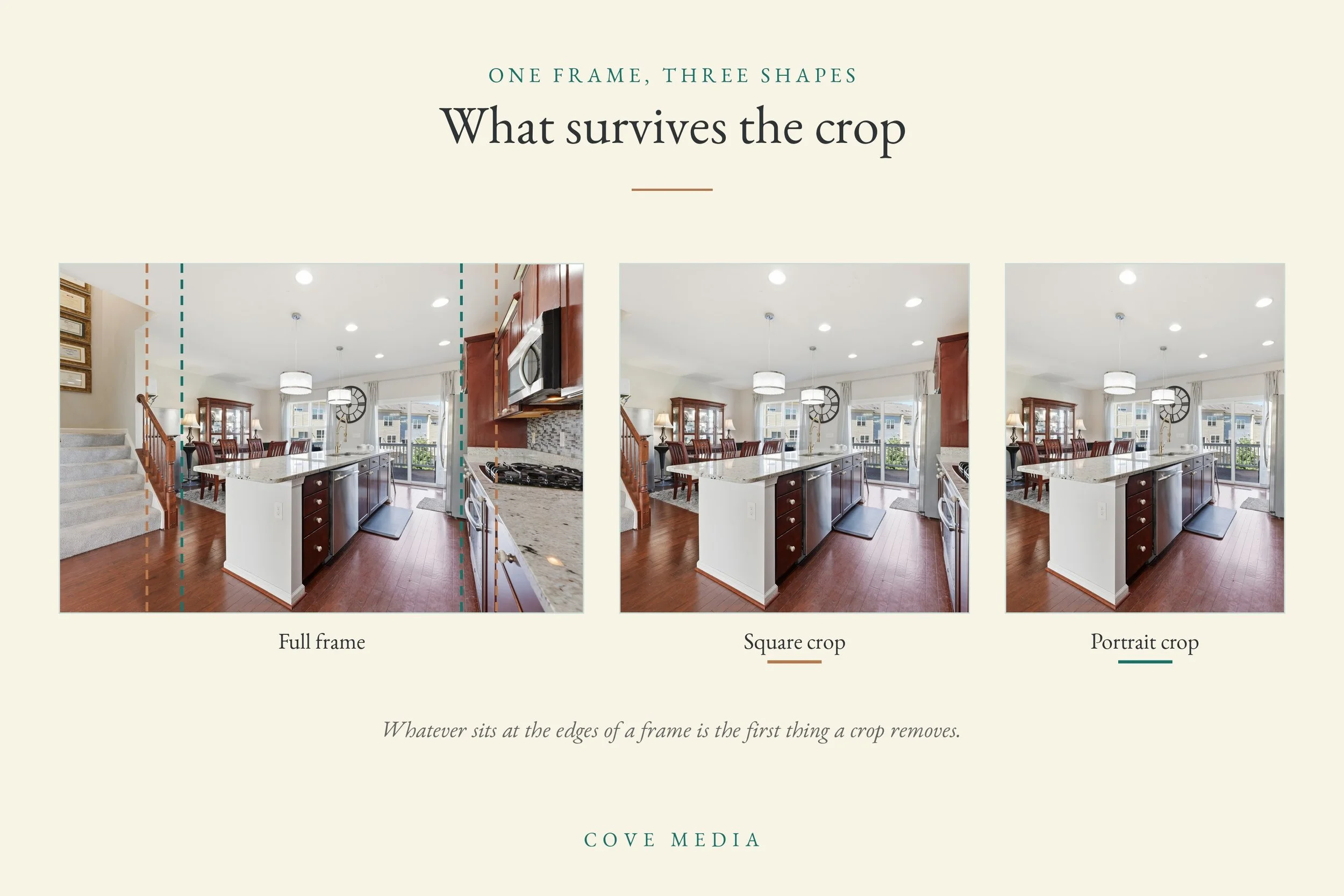
Consider a wide interior with something load-bearing at each edge — a staircase on the left, a gas cooktop on the right. In the full frame it reads as one connected floor: cook here, eat there, upstairs is that way. A square thumbnail crop takes the center and loses both ends, and with them the whole argument the photograph was making. A portrait crop for social keeps even less.
This is why the shot list matters more than the shot count. A frame with its subject dead center survives every crop. A frame that earns its value from edge-to-edge context survives only where it is shown whole. A good set has both, chosen deliberately.
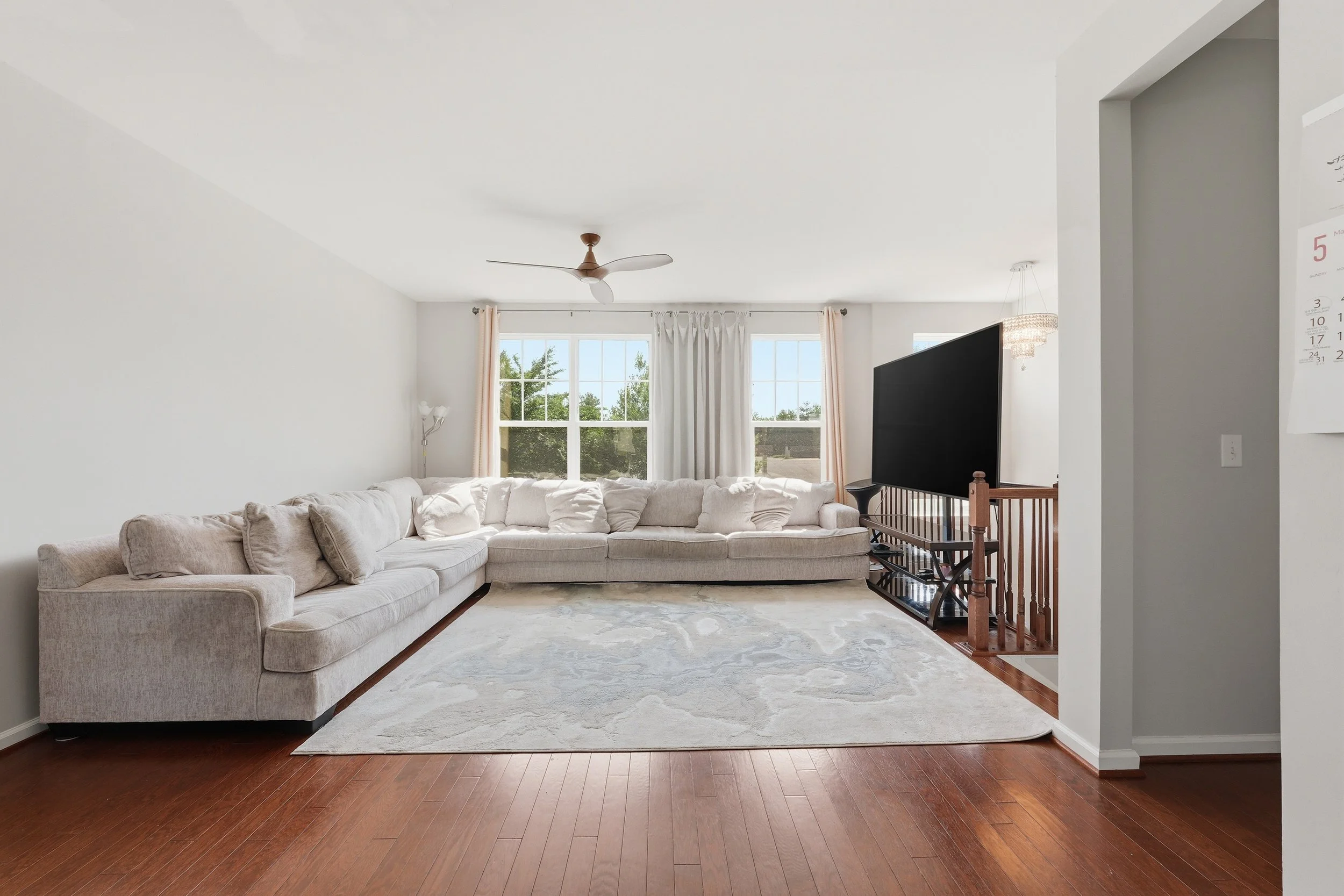
Centered on the windows. This one crops to a square or a portrait and still reads as the same room.
2. What Bright MLS actually requires
Bright MLS is the multiple listing service for DC, Maryland and Northern Virginia, and its published rules on images are shorter and more specific than most agents expect.
One photo has to be a curbside view. The set must include a view of the property from the curb, showing it as a visitor sees it on arrival. New construction may use an architectural rendering of the exterior elevation or the floor plan instead.
But the curbside photo does not have to lead. Bright's rule on the lead image reads, in its entirety: "One photo is selected to be displayed as the primary photo." Nothing in it says the primary photo must be the exterior. The two rules are commonly read as one, and they are separate — which is why a condo listing can lead on its best interior and still satisfy the curbside rule further down the set.
Nothing may be written on the images. Bright bars "any readable text, graphics, contact information" of the listing office, the agents, the seller "or any other person or service provider involved in the marketing, sale or lease of the property," along with "any text or graphics that have been added or superimposed" and "any signs or identifying logos." A slogan, a brokerage logo, a photographer's watermark in the corner — all prohibited. The same rule bars images of any identifiable person.
Virtually staged images must be disclosed. The rule is one sentence: "Virtually-staged photo(s)/rendering(s) must be disclosed in the MLS." It names no particular field. The rules around it draw a line worth knowing. Digitally adding furniture, mirrors, artwork and plants to an empty room is permitted, as is replacing existing furniture with digital furniture. Editing anything not within the owner's control is prohibited in either direction: Bright's examples are removing power lines, water towers or nearby highways, and adding a view that is not physically possible from that spot.
Bright's rules say nothing about file formats, file sizes, pixel dimensions or aspect ratios. The specifications that circulate on photography blogs are not Bright's.
3. The portals, and what travels with the photo
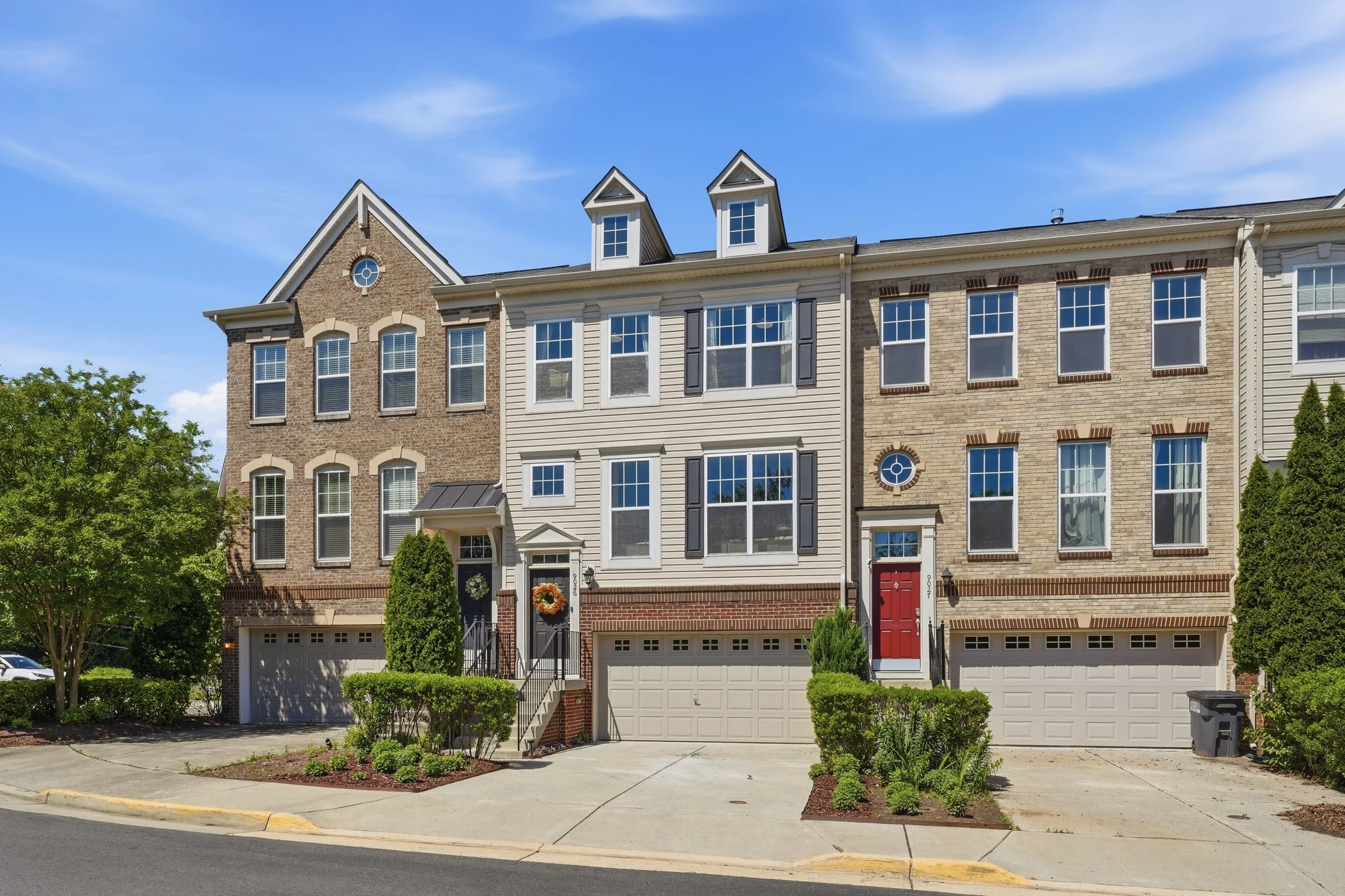
An attached row, framed on the center unit. In a tight thumbnail, which home is for sale is far less obvious.
Zillow, Redfin, Realtor.com and the IDX search on a brokerage's own website generally receive listing photos through the MLS, not from the photographer. That routing has two consequences agents feel but rarely trace.
The first is compositional. Portals crop to their own grid, and an attached row like the one above is where it bites hardest: a tight thumbnail of three attached facades does not tell a buyer which one is for sale. A frame that isolates the subject unit — or a wider establishing shot that makes the position obvious — does work the thumbnail cannot do on its own.
The second is legal, and it runs upstream. Uploading to Bright means granting Bright, in the words of its own rules, "a non-exclusive, perpetual, worldwide, transferable, royalty-free license to use, distribute, reproduce, display, adapt, create derivatives of, perform, and distribute the Listing Content … and to sublicense such rights through multiple tiers." That sublicense is how a photograph reaches the portals. And the party making that promise is the agent, not the photographer: the subscriber warrants that they "own the copyright or ha[ve] obtained the necessary Consents" to grant it.
Which leads to the part most agents have never been walked through.
4. Who owns the photographs
Under federal copyright law, the photographer owns the pictures from the moment the shutter fires. Copyright vests initially in the author (17 U.S.C. §201(a)), and owning a copy of the files is not the same as owning the copyright in them. Bright's own rules put it plainly: images "typically are presumed to be owned by the photographer/videographer unless there is a written license or assignment."
The common assumption is that commissioned work is "work made for hire" and therefore belongs to whoever paid. For a listing shoot, that is almost never right. Section 101 offers two routes: work by an employee within the scope of employment, or a specially commissioned work that falls into one of nine listed categories and is covered by a signed written agreement saying so. A standalone photograph is not one of the nine. The US Copyright Office's own guidance applies the same test.
What does transfer ownership is an assignment, and under §204(a) a transfer is not valid unless it is in writing and signed by the copyright owner. Bright's rules anticipate this: where the subscriber did not take the photo, "a copyright release must be obtained from the individual holding the copyright interest."
The flip side is that a license does not always need paperwork. The signed-writing requirement applies to transfers and exclusive licenses. A non-exclusive license can be oral or implied from conduct, so an agent with no written terms usually has something — just something whose scope nobody has defined until it is disputed.
There is no standard license. When the Ninth Circuit examined a large listing-photography company's agreements, it noted that each client agreement "differs slightly." Zillow's own agreements with its listing feeds split photo rights into "evergreen," with no time limit, and "deciduous," usable only while the listing is active. The only way to know which kind an agent holds is to read the agreement.
Who owns the copyright, and what it takes to transfer it, is set by federal law, so the answer is the same in DC, Maryland and Virginia. The terms of a particular license are still a matter of contract.
This is general information, not legal advice.
5. When the listing changes hands
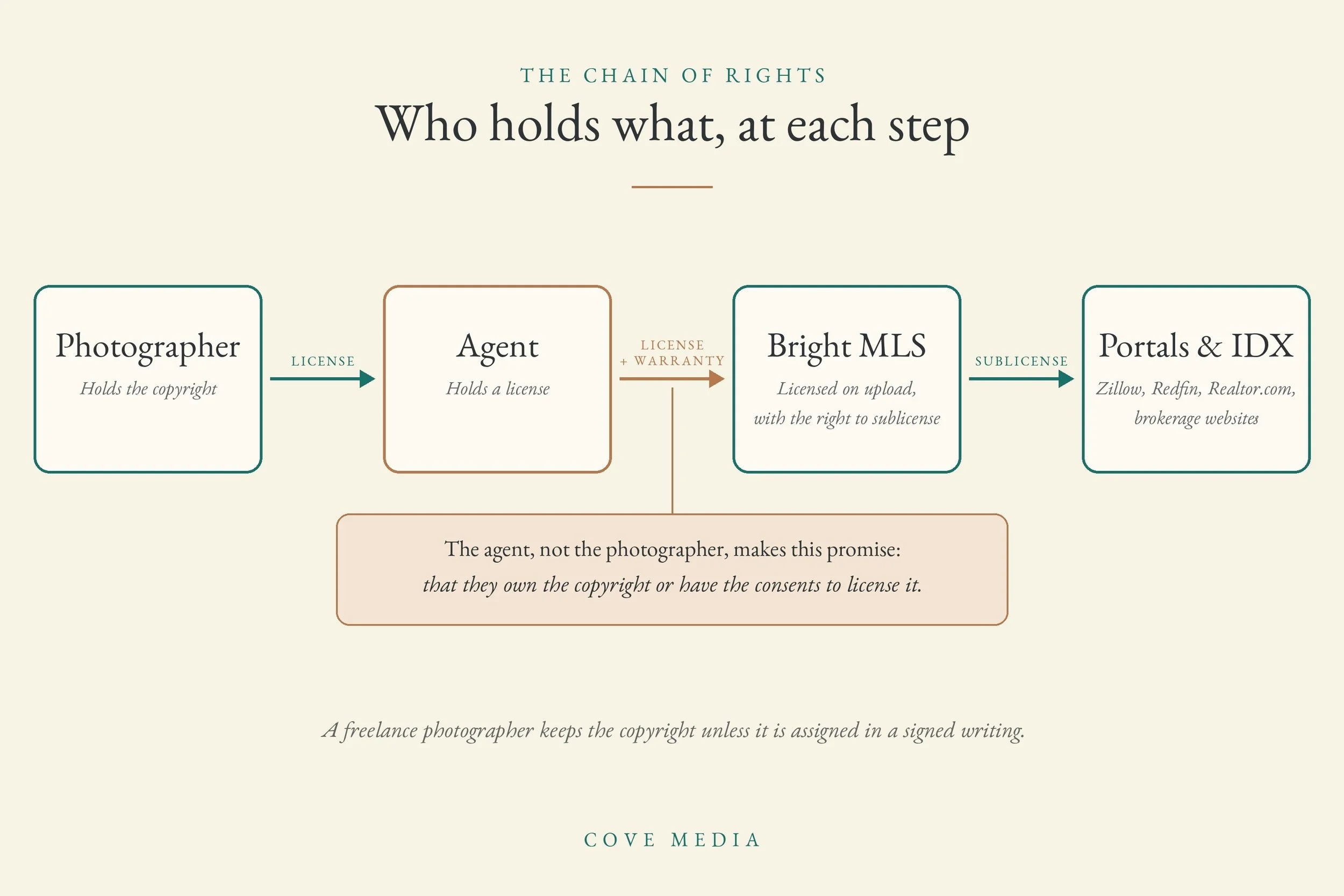
Three situations come up constantly in this market, and they have clearer answers than their reputation suggests.
A listing expires and a new agent relists the house. Bright is explicit. Its rules prohibit using photographs, virtual tours, remarks and other content "from a prior listing of a property for a current listing of the property without the express consent of the owner of proprietary rights in the media content." Consent is obtainable — often simply by commissioning the original photographer — but it is required, and reusing the old gallery without it is a rules violation before it is anything else.
An agent moves brokerages. This one cannot be answered generically. Under NAR's MLS policy, the listing broker owns the listing agreement and should own, or have the authority to license, the listing content before it goes into the MLS — which is not the same thing as owning the photographs. Whether the photographer's license ran to the agent or the brokerage, and whether it transfers at all, depends on the license and on the agent's independent-contractor agreement. Those documents vary.
The seller wants copies. Also contract-dependent. Some photographers grant homeowners personal-use rights as a matter of course; others do not.
The through-line: the exposure is per image, not per gallery. In 2023 the Ninth Circuit held that each of roughly 2,700 photographs in a listing-photography company's suit against Zillow was its own work, with its own award, even though they had been registered together as part of a database. A thirty-frame shoot is thirty separate works. That is the reason to get the license right once rather than assume it.
For balance: the same litigation went Zillow's way on its main listing platform. The court found Zillow had not chosen those images — the feed providers selected and uploaded them and certified their rights to use each one. That is the same kind of promise an agent makes to Bright on every upload.
The case closest to home involves a DC photograph. In 2019 the Fourth Circuit — which covers Maryland and Virginia — considered a photo of Adams Morgan at night, used without permission to promote the Northern Virginia International Film and Music Festival. The court found all four fair-use factors against the festival's producer, called the use non-transformative and commercial, and noted that photographs "have long received thick copyright protection." Commercial reuse of someone else's photograph is not fair use in this circuit.
6. Print, signage and the one that gets forgotten
Print is where a web-sized file fails visibly. An image that looks clean on a portal can go soft on a flyer and worse on a sign rider, because print asks for more pixels per inch than a screen does and there is no way to add detail that was never delivered.
The practical answer: ask for the full-resolution files at delivery and keep them, even when the only immediate use is the MLS. The MLS-sized set is a derivative — fine for its purpose, and not a substitute for the original.
7. What a delivery folder should actually contain
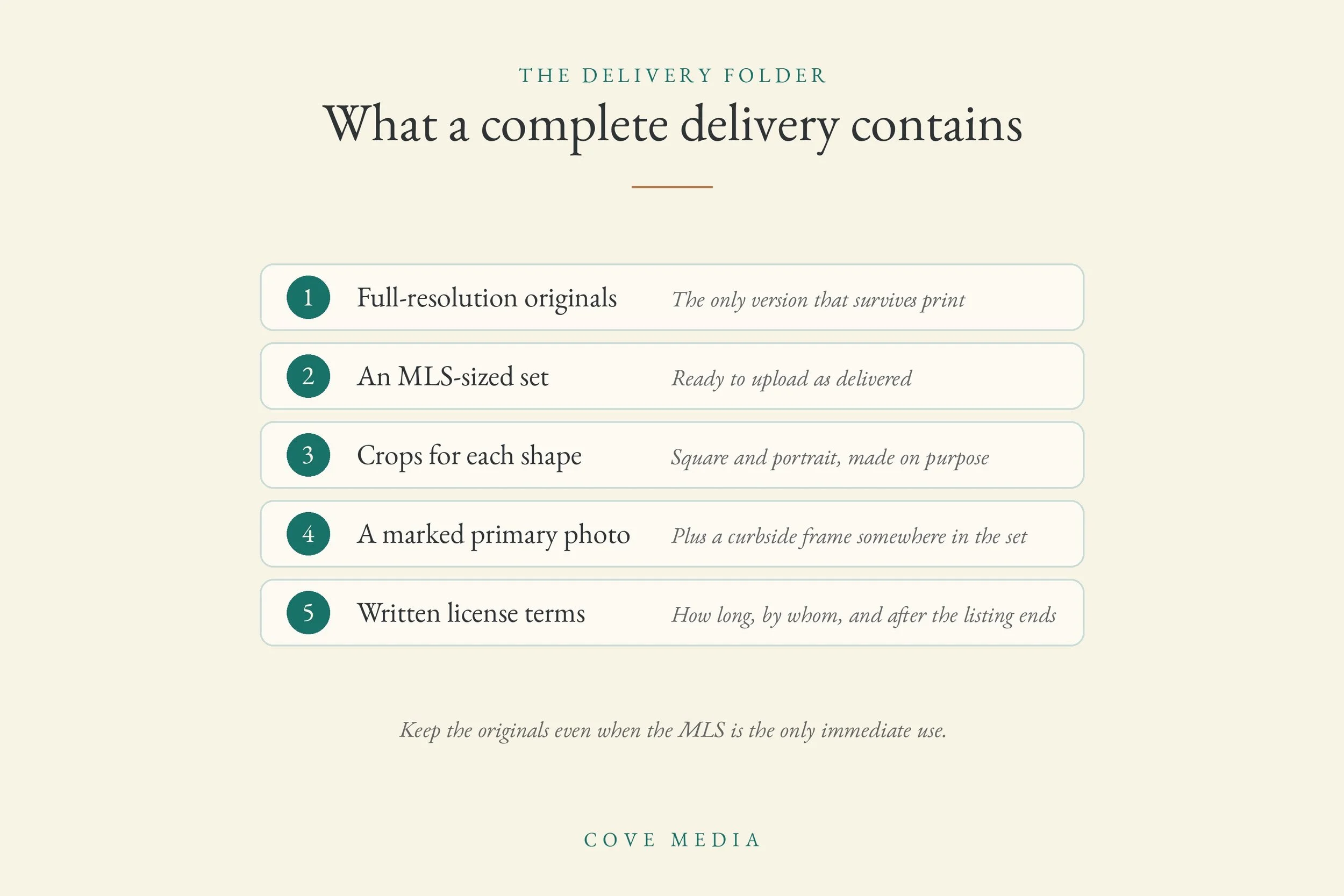
A delivery that prevents all of the above looks like this:
Full-resolution originals, kept regardless of immediate use — the only version that survives print.
An MLS-sized set, ready to upload without further handling.
Crops that already exist for the shapes the listing will actually appear in, rather than being improvised later from whatever is to hand.
A clearly identified primary photo, chosen deliberately — with a curbside frame in the set to satisfy Bright's rule whether or not it leads.
License terms in writing, covering how long the images may be used, by whom, and what happens when the listing expires or the agent moves.
Cove Media delivers both a full-resolution and an MLS-sized gallery with every shoot across DC, Maryland and Northern Virginia. What's included in a shoot covers the rest of the deliverable, and the questions worth asking before booking covers what to establish with any photographer up front — usage rights among them.