Fall Real Estate Photography in the DC Metro Area: Shorter Light, Better Listings

Fall is the best-looking season in the DC metro area and, on paper, the hardest one to schedule around. Between mid-September and the end of November the daylight window collapses by nearly two and a half hours on the clock, the foliage runs on a different timetable in western Loudoun than in Arlington, and one Sunday in November takes an hour off every afternoon at once.
That used to mean chasing light. It mostly doesn't anymore. The scheduling math below is still worth knowing — but most of what fall used to cost a listing is now handled after the shoot rather than during it.
1. What actually changes between September and November
Three things, and they compound.
The first is where the daylight sits in the workday. A 4:00 p.m. appointment in September is comfortable mid-afternoon light. By November 30 that same appointment has forty-seven minutes of daylight left in it.
The second is the trees. Peak color runs about two weeks in any given neighborhood and does not wait for a listing to be ready — a house that photographs beautifully on October 18 can look like a different property on November 8.
The third is the ground and the sky — leaf litter, bare branches, flat overcast. Each one used to force a compromise. Each one is now largely an editing question rather than a shooting one.
2. The golden-hour window is shrinking — and why it matters less than it used to
Here are the real numbers, because they still govern when a photographer can be on site.
According to the US Naval Observatory, sunset in Washington, DC on September 16 is 7:15 p.m., with civil twilight ending at 7:41 p.m. On October 31 sunset is 6:09 p.m., and by November 30 it is 4:47 p.m. — an hour and twenty-two minutes earlier than Halloween, and two hours and twenty-eight minutes earlier on the clock than mid-September.
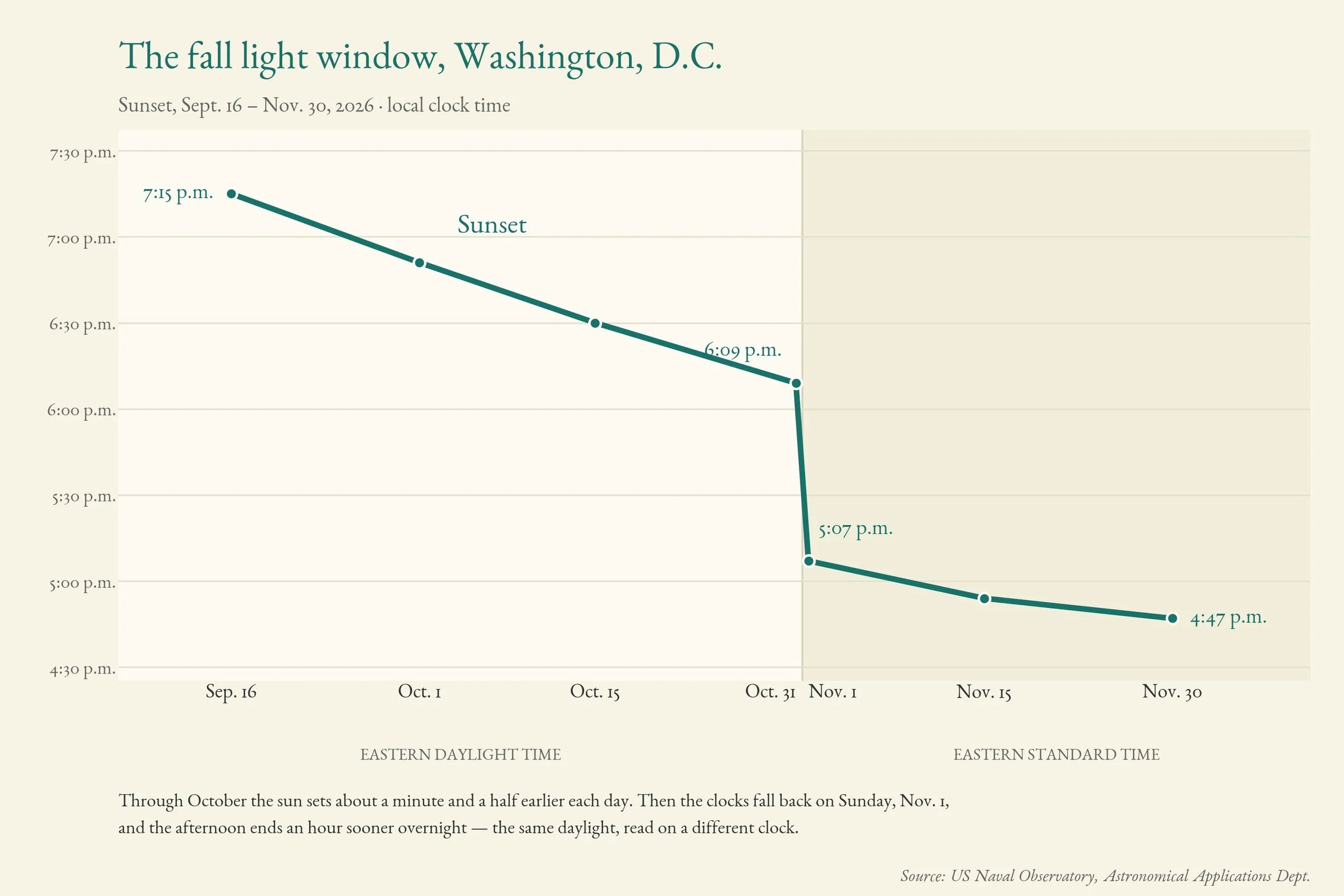
Through October the sun sets roughly 1.4 minutes earlier each day — about ten minutes a week. A 5:30 p.m. exterior that had eighty minutes of light before sunset on October 1 has under forty by Halloween.
Here is the part that has changed. Cove Media does not sell golden-hour sessions, and no longer builds schedules around that last warm hour before sunset, because virtual twilight has gotten good enough to make the trip unnecessary. Booking a photographer into a narrow, weather-dependent window at the end of a fall afternoon buys a look that can now be produced from a midday frame — reliably, on any day of the week, without asking a seller to be out of the house at dusk.
What the shrinking window actually constrains is the ordinary daytime exterior. Daylight is still required. That specific daylight is not.
Cove Media's guide to the best time of day for real estate photography covers how that window behaves month to month.
3. Foliage timing across the region
The most common fall scheduling mistake is treating the DC metro area as one place with one peak.
The Virginia Department of Forestry describes a season that starts in the mountains and works east: color begins "earliest in the higher elevations and moving eastward," and statewide, fall colors "generally peak sometime between October 10 and October 31," with the dates varying year to year with temperature and rainfall. Their foliage map splits the state into three bands — western Virginia typically peaking October 10–20, central Virginia October 15–25, and eastern Virginia October 20–31.
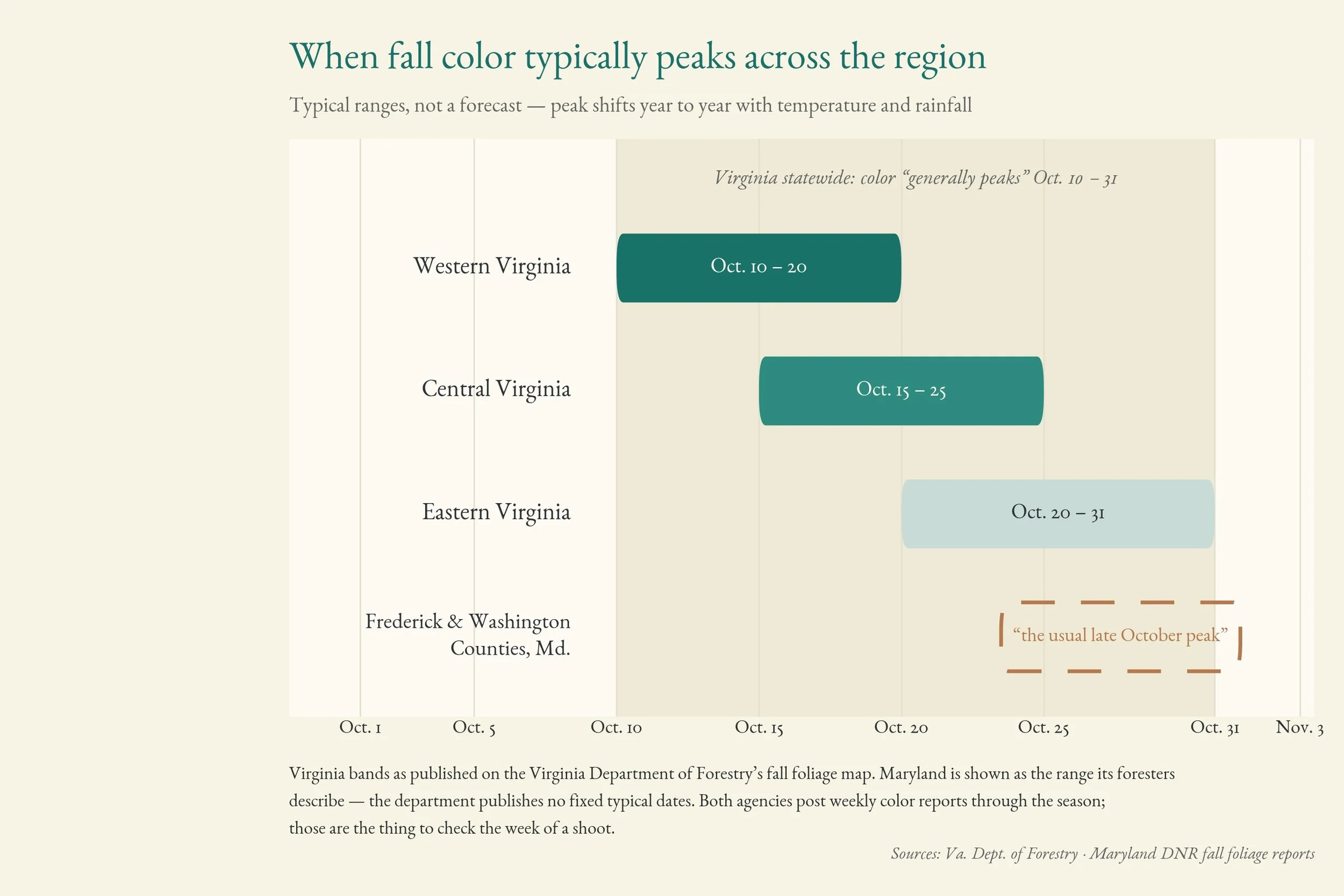
Across the Potomac, Maryland's Department of Natural Resources publishes weekly foliage reports every Thursday from mid-to-late September into November, and its foresters have described "the usual late October peak for Frederick and Washington Counties." A listing in the western part of the region and one closer to the water are roughly two to three weeks apart.
Neither agency publishes a peak date for the District itself or the inner suburbs, so anyone quoting a precise Arlington or Bethesda peak week is guessing. And because peak moves with the weather, the reliable move is to check what the state agencies are reporting the week of the shoot rather than booking against a calendar date. Both publish through the season, and both are free.
4. Leaf litter, bare trees, and gray skies
Most fall listings are not shot during peak color, and the ones that come to market in November are not shot anywhere near it. Ten years ago that meant a compromise. Now it mostly means a line item.
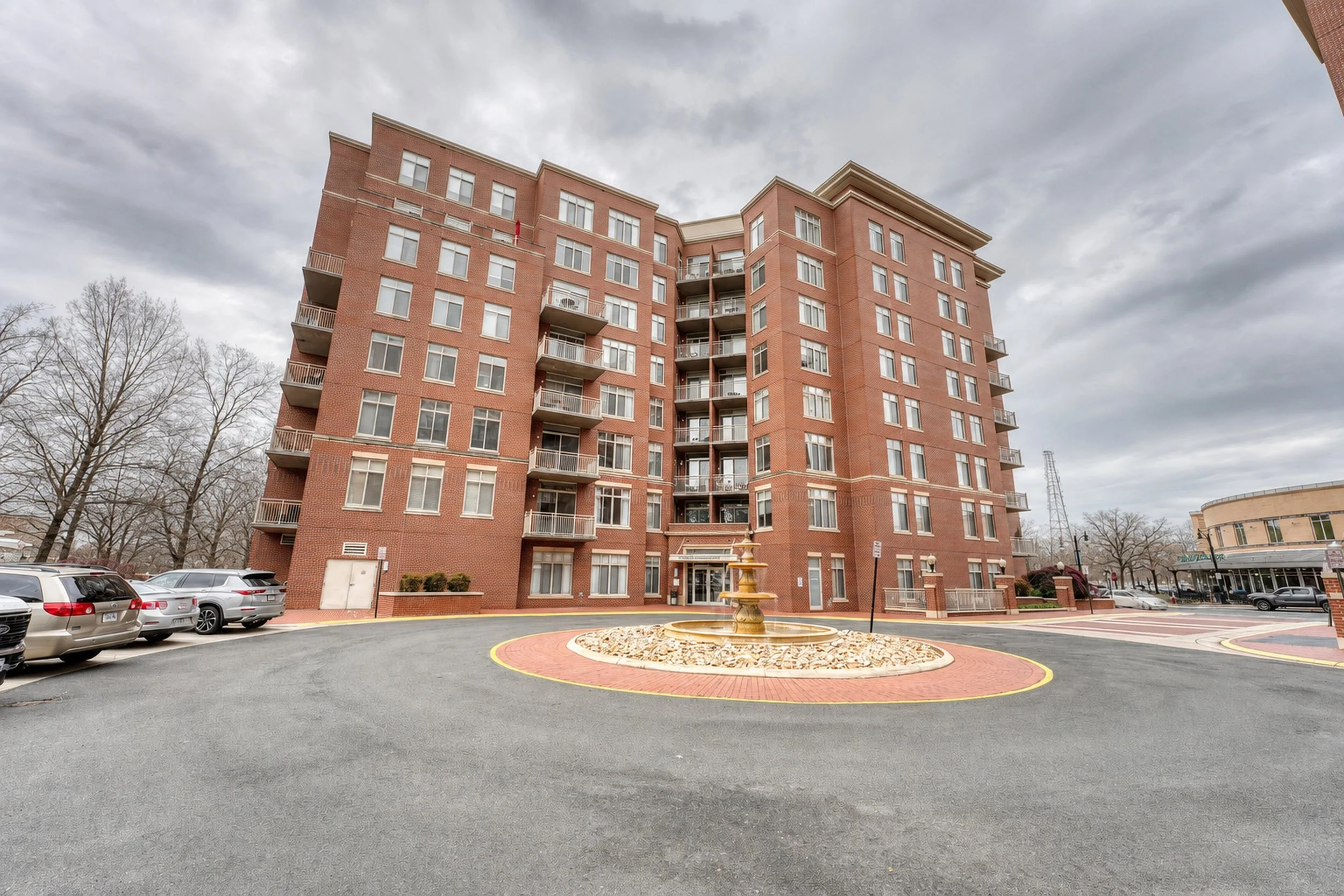
Flat overcast and bare branches — no directional light, and a white sky doing none of the work.
Leaf litter is what sellers worry about most and what matters least now. Fallen leaves come off a lawn and walkway cleanly in editing — a few spot cleanups are included at no charge, and replacing a whole lawn runs $10 per image. A yard that did not get blown that morning is no longer a reason to move a shoot, and nobody needs to chase a windy October evening for a clean front yard.
Bare branches are not a problem for the house at all. A leafless canopy lets more light onto a façade and opens sightlines that summer foliage hides.
Flat overcast is the one that used to do real damage: no directional light, no shadow to describe a roofline, and a blank white rectangle over the property. Cove Media's image enhancement is included on every order and delivers clear blue skies regardless of the weather on the shoot day, so a gray Tuesday in November is no longer a reason to reschedule. Patchy or browned-out fall lawns are covered the same way, through grass replacement.
The practical upshot: the bar for a "good day" in the fall is far lower than it used to be. Book the date that works for the seller.
5. Season swap: when the calendar doesn't cooperate
Sometimes the timing does not work at all. A property shot in July comes to market in October. A relisting needs to look current without a return trip. A print piece needs fall color for a house shot under snow.
Cove Media's season swap converts outdoor photos to any season, adding the color, lighting and atmosphere to match. It is not a filter over green leaves — the edit takes in foliage, lawn condition and sky together, which is what makes it hold up at full size.
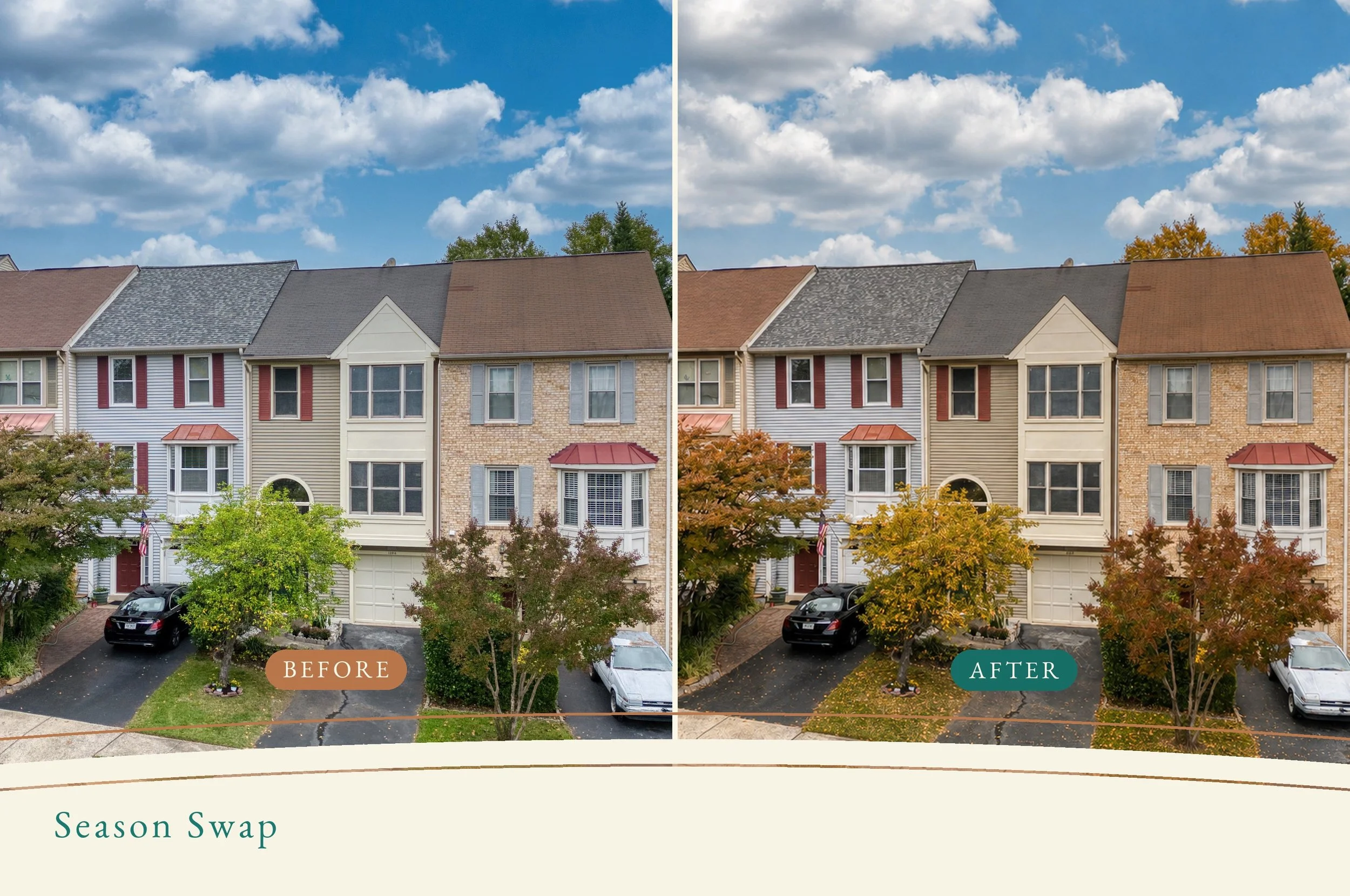
That comparison is a true pair — the same aerial frame of the same townhome row, same angle, same parked cars, nothing moved between them. Every difference is the edit.
Season swap runs $10 per image as a premium edit. It is built for marketing that has to match the season it is being read in: an agent's own site, social, print flyers and mailers, listing presentations, and coming-soon material that goes out before a reshoot is possible.
6. Twilight without the evening appointment
Twilight exteriors sell listings. The reason they were rare is that they were expensive in logistics: a photographer on site after sunset, a seller clearing out, every light in the house on, and one usable window of under half an hour.
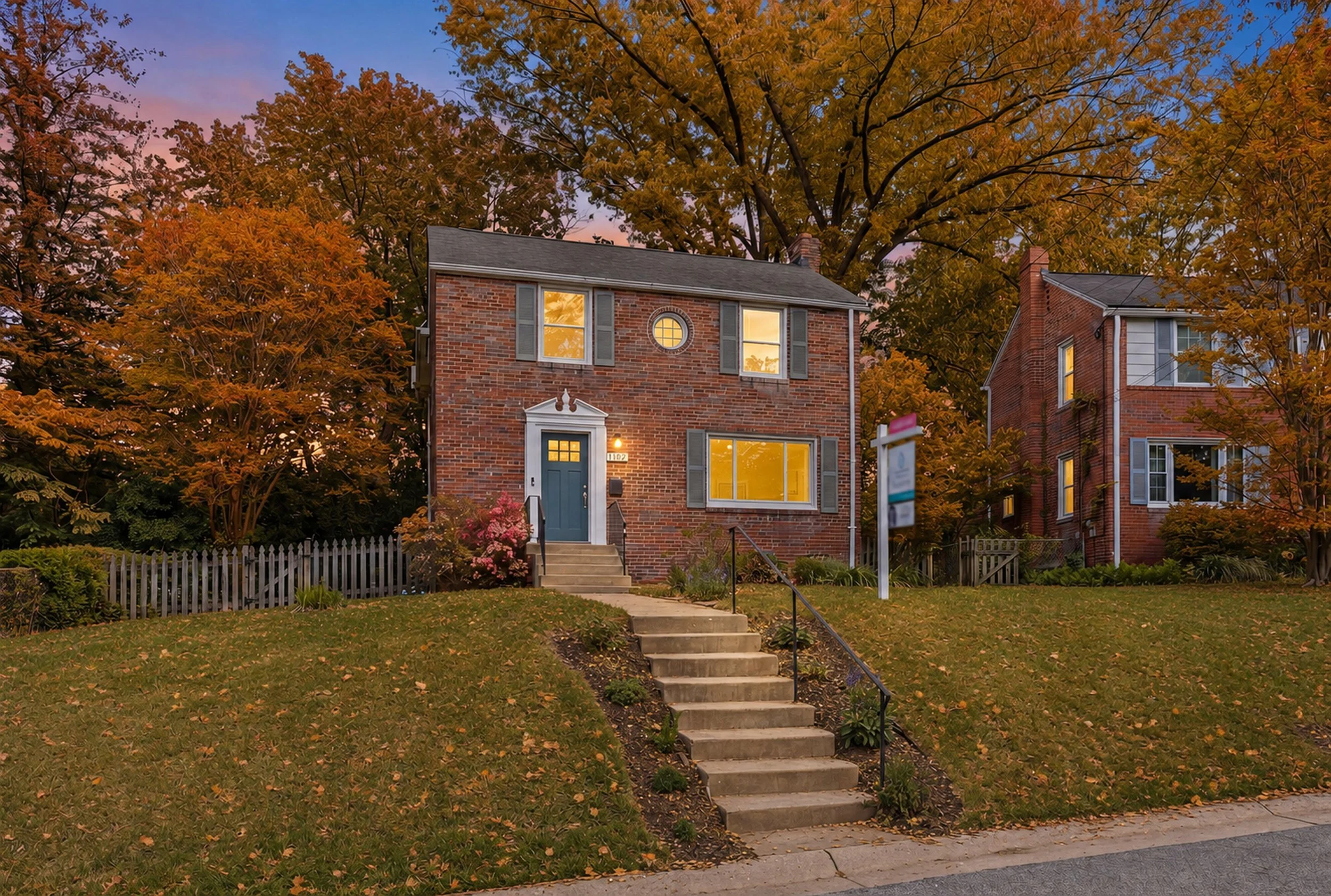
Warm interior light against a deep sky — the look that used to require an evening appointment.
Cove Media's virtual twilight produces that scene from an ordinary daytime photo for $85 — warm window light, dramatic sky, no evening call. In the fall that stops being a convenience and starts being the only sensible way to do it. By late November, true twilight in Washington falls around 5:00 p.m. on a weekday, which is the worst possible time to ask a seller to be ready and a photographer to be across town.
The shoot happens whenever it happens. The twilight frame gets made afterward, and it looks the same in November as it does in June.
7. The November 1 clock change and afternoon bookings
Daylight saving time ends on Sunday, November 1, 2026, at 2:00 a.m. local time, when 2:00 a.m. EDT becomes 1:00 a.m. EST. The date is fixed by federal statute as the first Sunday in November, and NIST — which operates time.gov — describes the change the same way.
The effect is abrupt rather than gradual. Sunset on Saturday, October 31 is 6:09 p.m. Sunset on Sunday, November 1 is 5:07 p.m. Nothing about the daylight changed; the clock did. Every recurring afternoon slot on the calendar just moved an hour later relative to the light.
In practice the last comfortable daylight exterior moves from about 5:00 p.m. in late October to about 4:00 p.m. that first week of November. Agents holding a standing late-afternoon slot are the ones who get caught.
8. Booking ahead of the shift
Fall compresses the schedule from both ends: fewer usable hours per day, and a small number of weeks with good color. The good slots go early.
Book daytime exteriors for the light, not the convenience. In November the difference between a 2:00 p.m. and a 4:30 p.m. exterior is real. This is the one piece of timing that editing cannot recover.
Watch the state foliage reports, not the calendar. Virginia's Department of Forestry and Maryland DNR both publish weekly through the season. A week of flexibility, used well, beats a month of planning against a fixed date.
Stop paying for perfect conditions. Leaves, gray skies and tired lawns are handled after the shoot. Book the date that works.
Add virtual twilight to fall listings. It is $85, it needs no evening appointment, and it is the strongest frame in most fall sets.
Cove Media shoots listings across DC, Maryland and Northern Virginia from a base in Rockville, with photography sold in sets of 20, 40 or 60 images. Fall dates fill from the peak-color weeks outward.
For the opposite end of the year, Cove Media's guide to summer real estate photography in the region covers the heat, haze and harsh-light problems that run counter to everything here.