What's the Best Time of Day for Real Estate Photography in the DC Metro Area?
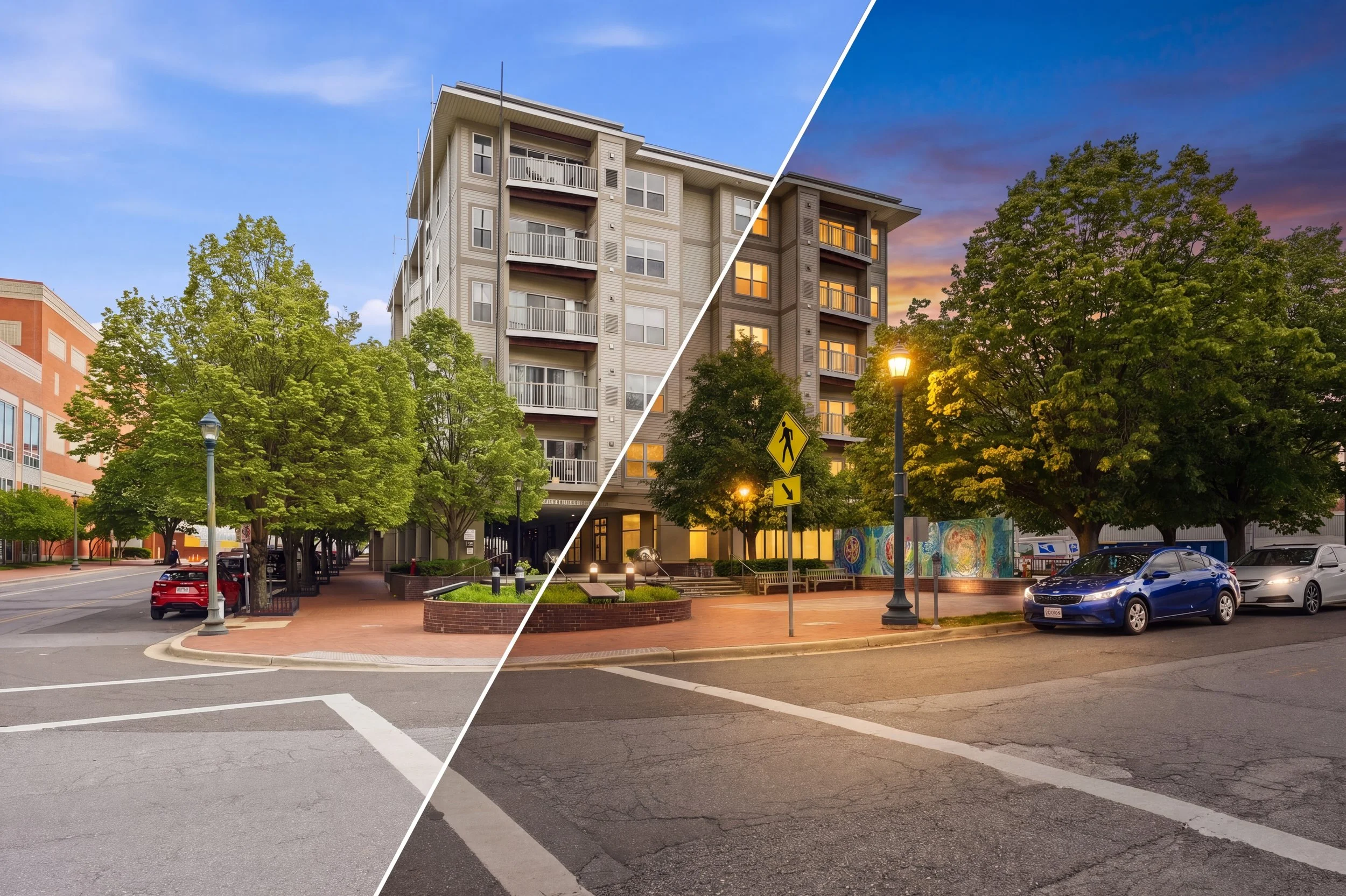
The time of day your photos are captured can change the look of your images entirely.
It's one of the most common questions agents ask when scheduling a shoot. The honest answer is that modern HDR bracketing has made timing more flexible than most people assume — but it still matters, especially for exterior shots. Here's what actually moves the needle in the DC metro.
How HDR bracketing changes the equation
Traditional real estate photography was heavily dependent on shooting at the right time. Single-exposure cameras had to capture everything in one frame — which meant windows blew out, dark corners stayed dark, and mixed lighting was a real problem.
HDR bracketing works differently. The camera fires a rapid sequence of exposures, from underexposed to overexposed, and those frames are blended in post. Windows come out natural, rooms are properly lit, and the image reads the way the space actually looks in person. For interiors, this essentially removes timing as a scheduling concern. You're capturing data and building the image afterward, not racing the light.
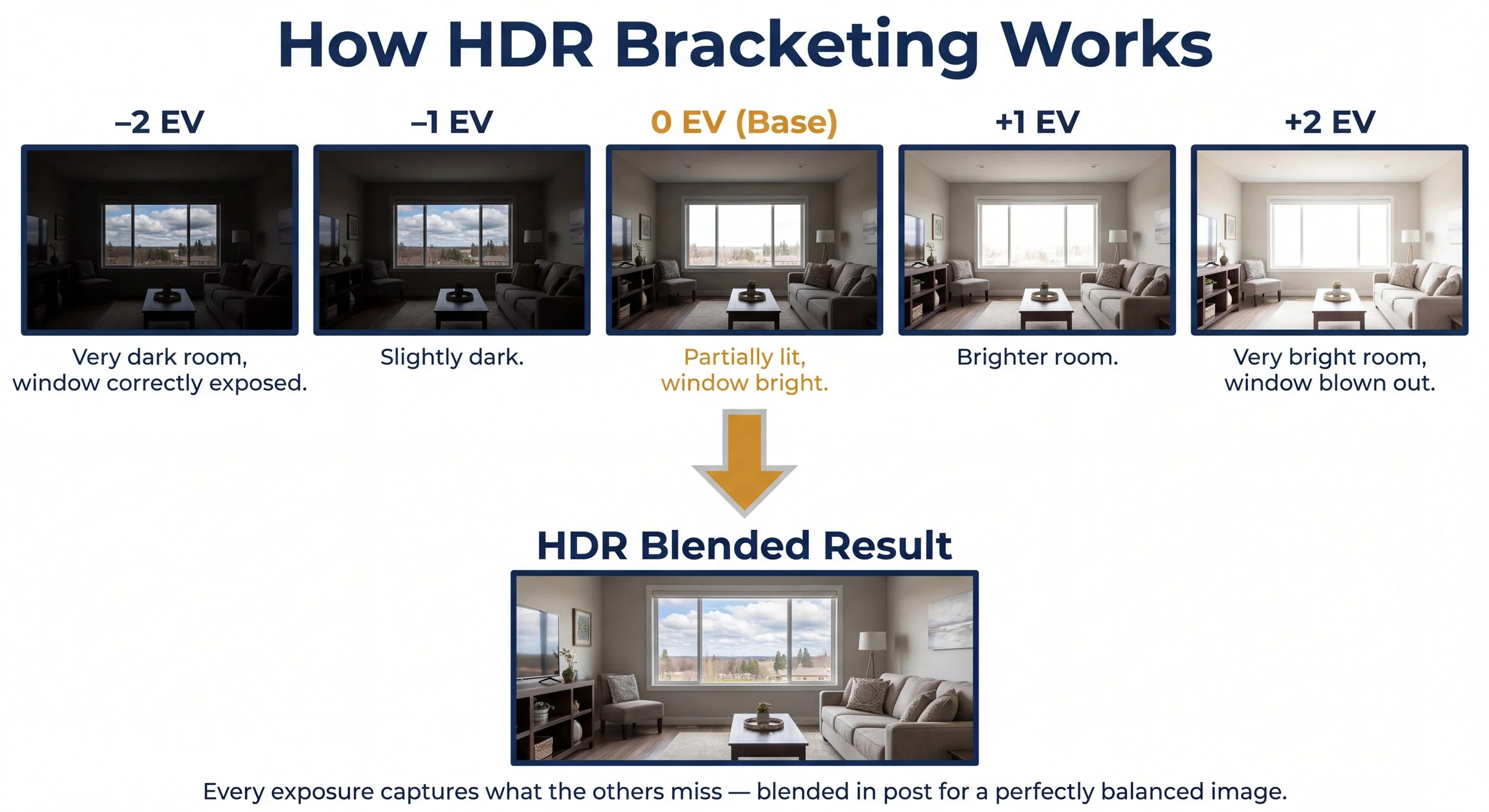
How HDR bracketing works — multiple exposures blended into one balanced image.
Morning: the practical sweet spot
For most DC metro homes, morning remains the best default window — not because of dramatic golden light, but because of logistics.
Quieter streets. Northern Virginia neighborhoods see heavy commuter traffic through the afternoon. Morning shoots mean fewer parked cars blocking curb views and less through-traffic during exterior sequences.
Cleaner skies. On clear days, the DC metro develops hazy, washed-out skies by midday in summer. Morning skies tend to be more defined — which matters for drone aerials in particular.
Cooler temperatures. For late spring and summer shoots, morning is simply more comfortable for everyone. Sellers can air the home out before the humidity builds.
On orientation: if the front of the home faces east, direct sun will hit the facade in the early morning. Slightly later in the morning — 9 to 10 AM on a clear day — softens that effect. For north-facing homes and properties with significant tree cover, orientation matters much less, and any morning window works well.
Midday works better than its reputation suggests
Midday has a bad reputation in photography circles — overhead sun flattens exteriors and washes out skies on clear days. With HDR bracketing, it's considerably more workable than the old rules suggest.
North-facing homes don't receive direct front-facing sunlight at any hour. Midday is simply the brightest ambient window for those facades — making it the right call regardless of sky conditions. Similarly, heavily wooded lots in areas like McLean, Potomac, and Great Falls benefit from midday light that penetrates the tree canopy more evenly than low-angle morning sun, which creates dappled, inconsistent shadows.
For most other listings on a clear day, morning still edges out midday. But it's a reasonable window, not a last resort.
Golden hour: great light, but probably not worth it
Golden hour produces genuinely beautiful exterior light — warm, directional, long shadows, rich sky tones. A listing photographed at golden hour on a clear evening can look exceptional. This isn't in dispute.
The practical problem is that virtual twilight editing has made the real thing largely unnecessary for most listings. A standard daytime exterior photo can be edited in post to look like a twilight shot: deep blue dusk sky, enhanced window glow, warm exterior light tones. Done well, the result is essentially indistinguishable from a real on-site twilight session — at a fraction of the cost and with no scheduling complexity.
Real twilight shoots still make sense in a narrow set of circumstances: luxury properties where pool lighting, landscape lighting, or architectural exterior lights are major selling features and need to be captured authentically. For the vast majority of DC metro listings, virtual twilight delivers the same buyer impact without the constraints.
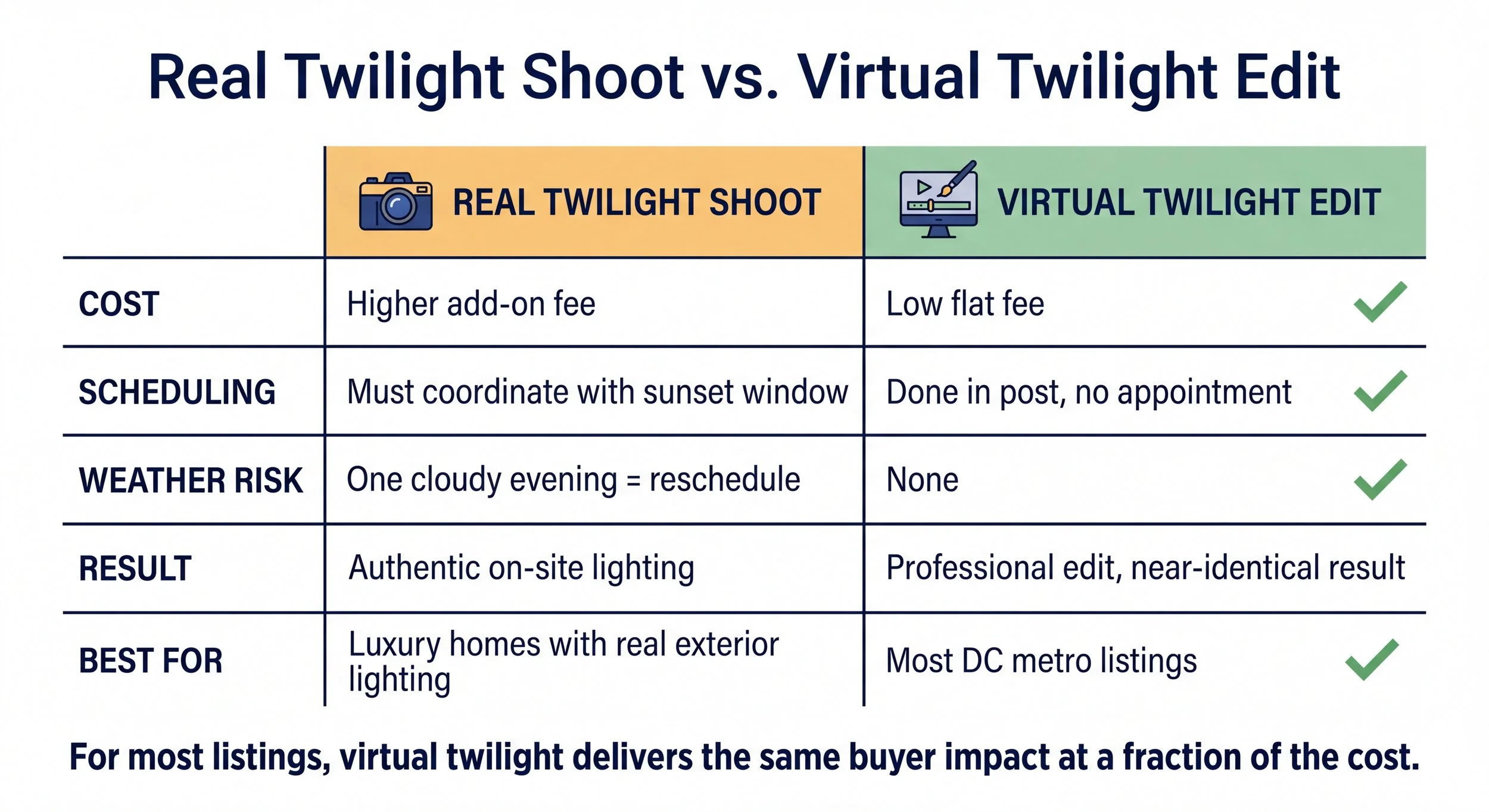
Real twilight shoot vs. virtual twilight edit — cost and complexity comparison.
How Cove approaches shoot timing
All Cove shoots are HDR bracketed as a baseline and wrap by early afternoon — no late-day or golden-hour appointments. That keeps things straightforward for agents and sellers and avoids afternoon rush-hour complications across Northern Virginia and Maryland.
Before every shoot, we note the property's orientation and the forecast and schedule accordingly. If conditions won't deliver good exterior results on the scheduled day, Cove offers free weather rescheduling. 24-hour delivery on all packages — listings go live the next morning.
Book your listing shoot
Timing questions are part of what we handle when you book — you don't have to figure it out yourself. Book at www.cove.media. Full pricing for all packages — HDR, drone, Matterport, twilight, and video add-ons — is at cove.media/pricing.
Service Area
Cove Media provides real estate photography across the Washington DC metropolitan area, including the District of Columbia, Northern Virginia (Arlington, Alexandria, Fairfax, Loudoun, Prince William) and Maryland (Montgomery, Prince George's, Howard, Anne Arundel, Frederick). All drone work is performed under FAA Part 107 certification with LAANC authorization where applicable.