How Long Does a Real Estate Photo Shoot Take? What DC Metro Area Agents Should Block Off
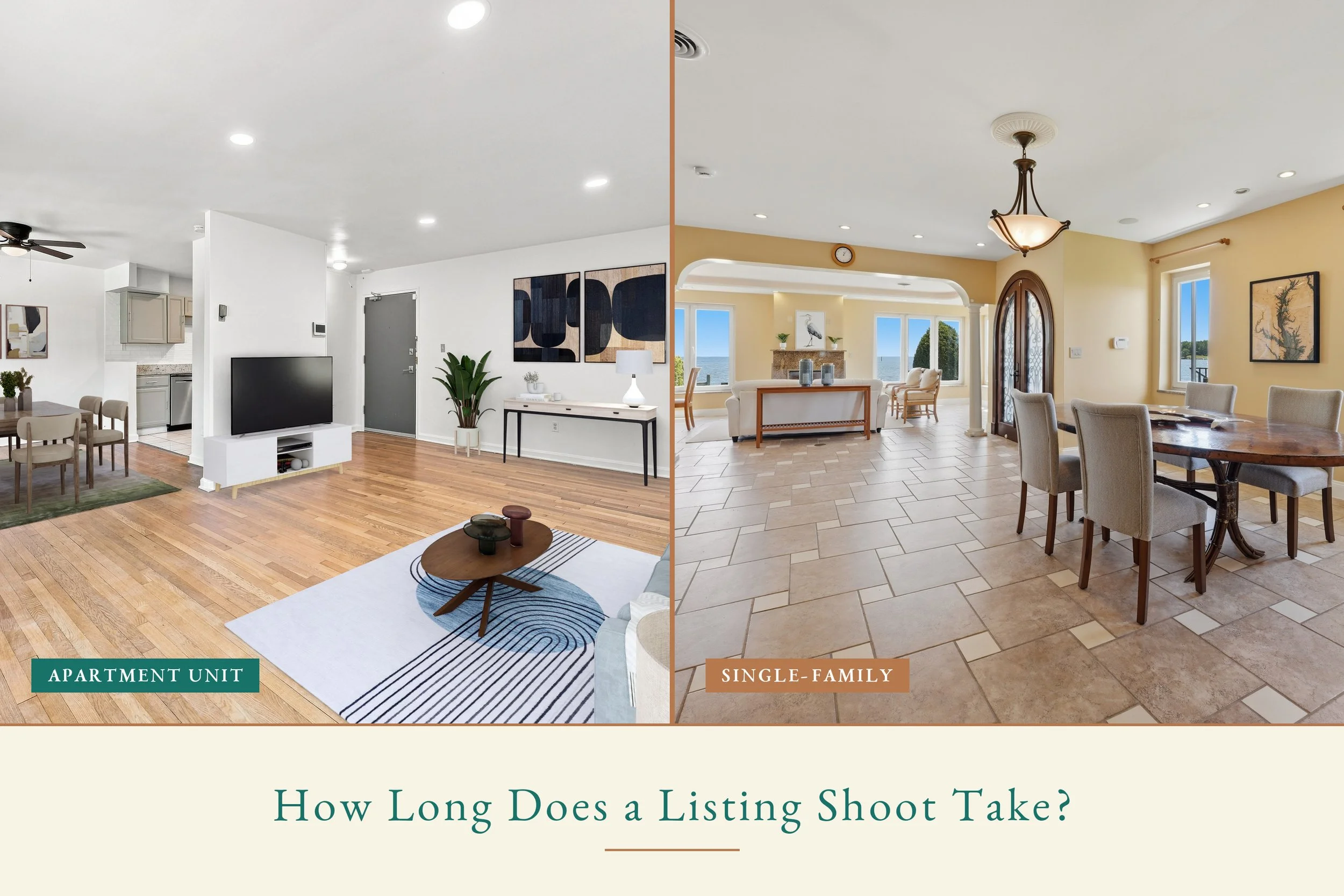
Agents ask for a time estimate roughly the way people ask a contractor for one — hoping the answer is short, then planning as though it will be. The dog walker gets booked for the wrong hour, or a listing appointment lands forty minutes after the photographer is due to arrive, and the last few rooms get shot in a hurry.
So here's the real answer, by property size, plus the two situations that add half again to every number below.
1. The short answer, by property size
Time tracks two things together: how big the property is, and how many photos it needs. Those move in step, which is why Cove Media's packages are built around three photo counts.
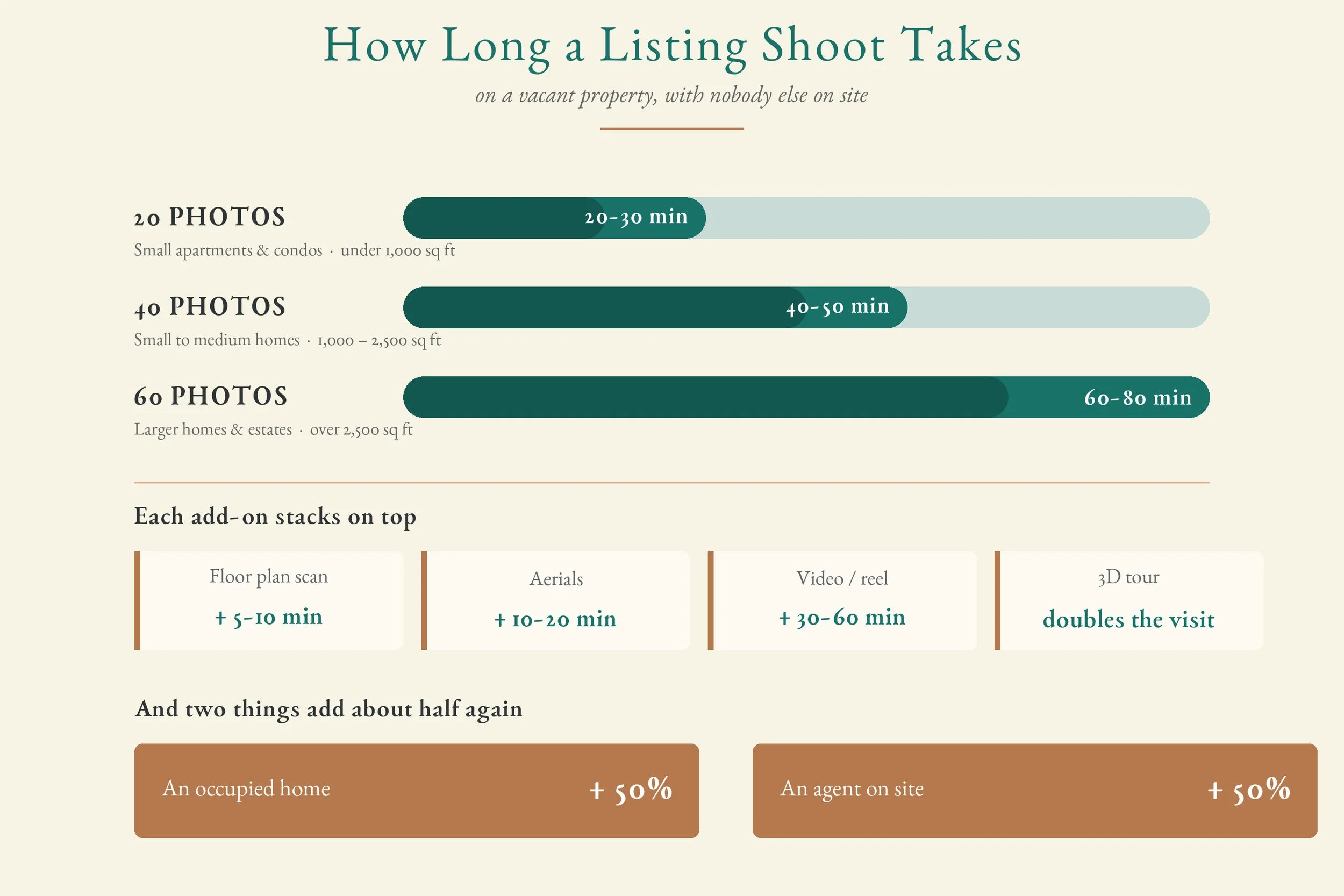
20 photos — small apartments and condos, under 1,000 square feet. Roughly 20 to 30 minutes. One living space, a bedroom or two, a kitchen, a bath. Add about 10 minutes if the building's amenities are wanted as well — lobby, gym, roof deck, pool.
40 photos — small to medium homes, 1,000 to 2,500 square feet. Roughly 40 to 50 minutes. This covers most townhomes and a good share of single-family houses in the DMV.
60 photos — larger homes and estates, over 2,500 square feet. Roughly 60 to 80 minutes. More rooms, longer sight lines, and more angles worth taking in each space.
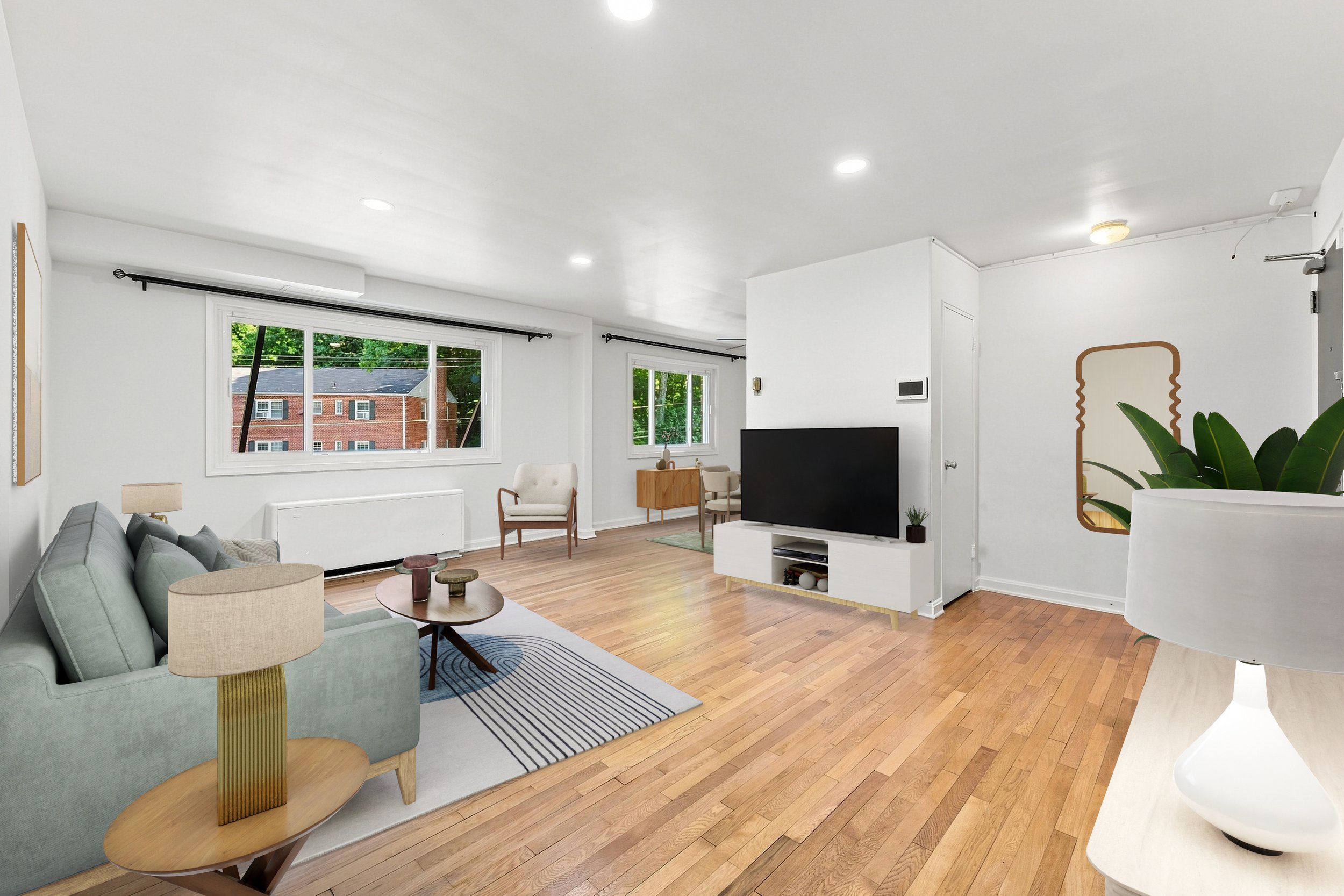
A unit this size is a 20-photo order and about half an hour on site.
Those are the shoot itself, on a vacant property, with nobody else there. Everything in the next two sections adds to them.
2. What's actually happening in that time
The short version: every room gets photographed several times over at different brightnesses, and those frames get combined afterwards into one.
That's HDR, and the reason for it is windows. Expose a room so the sofa looks right and the window behind it turns into a white rectangle. Expose for the window instead and the room goes dark. Taking both, and blending them later, is the only way to end up with a photo showing the living room and the backyard through the glass.
So each composition is a tripod position, a level check, a sequence of frames, and usually a second angle from the opposite corner. Add the small invisible things — closing a laptop, straightening a rug, turning every lamp on and the ceiling fan off. That's where the minutes go.
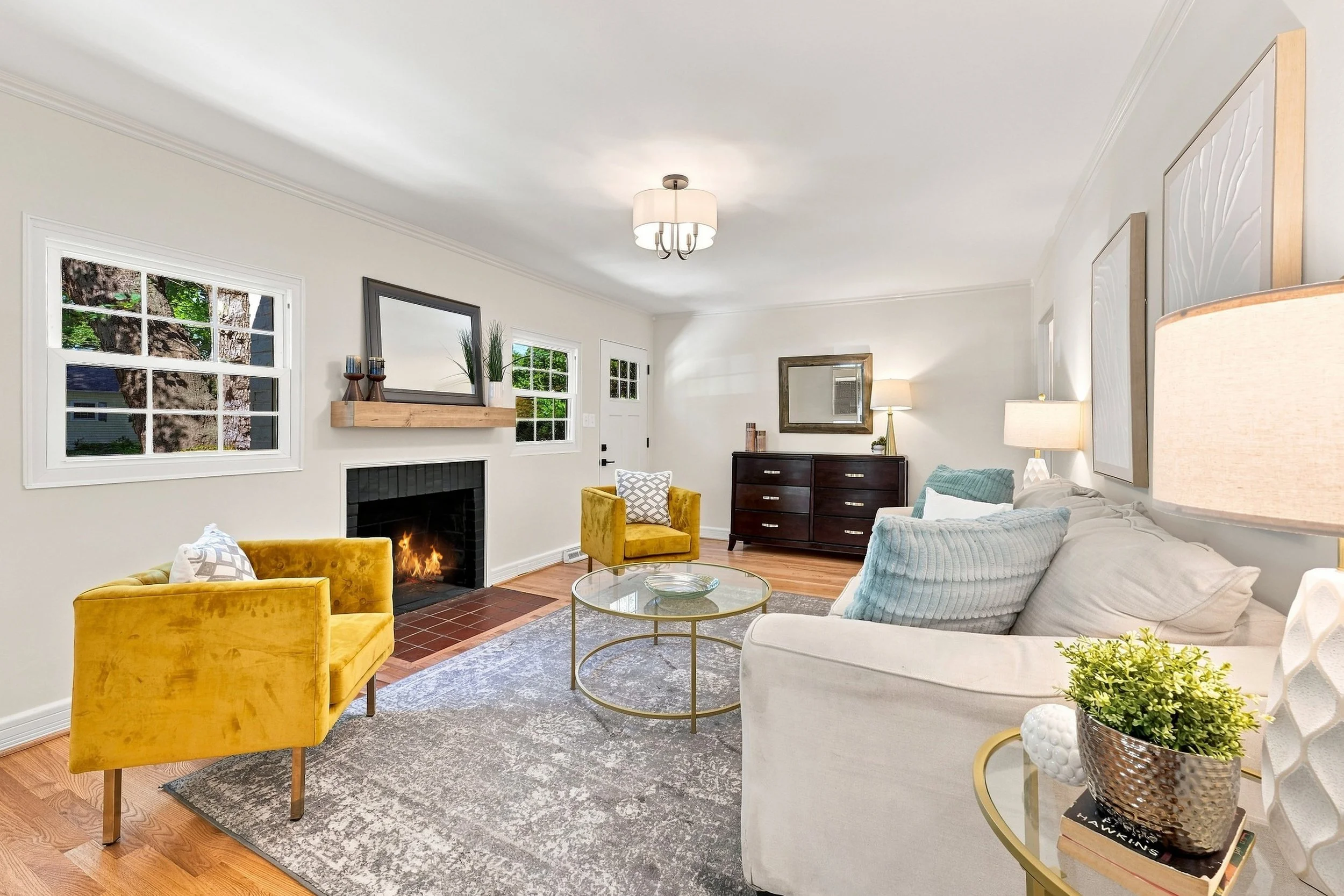
One exposure couldn't hold both the lit fireplace and the daylight outside those windows. Several, combined, can.
3. What each add-on costs you in minutes
Everything above is stills. Each add-on has its own setup, and they stack.
Aerials — 10 to 20 minutes. Launch, shoot, land, pack. Worth knowing that a good part of DC sits in restricted airspace, where the shot gets taken from a mast instead; Cove Media covered where you can and can't fly separately.
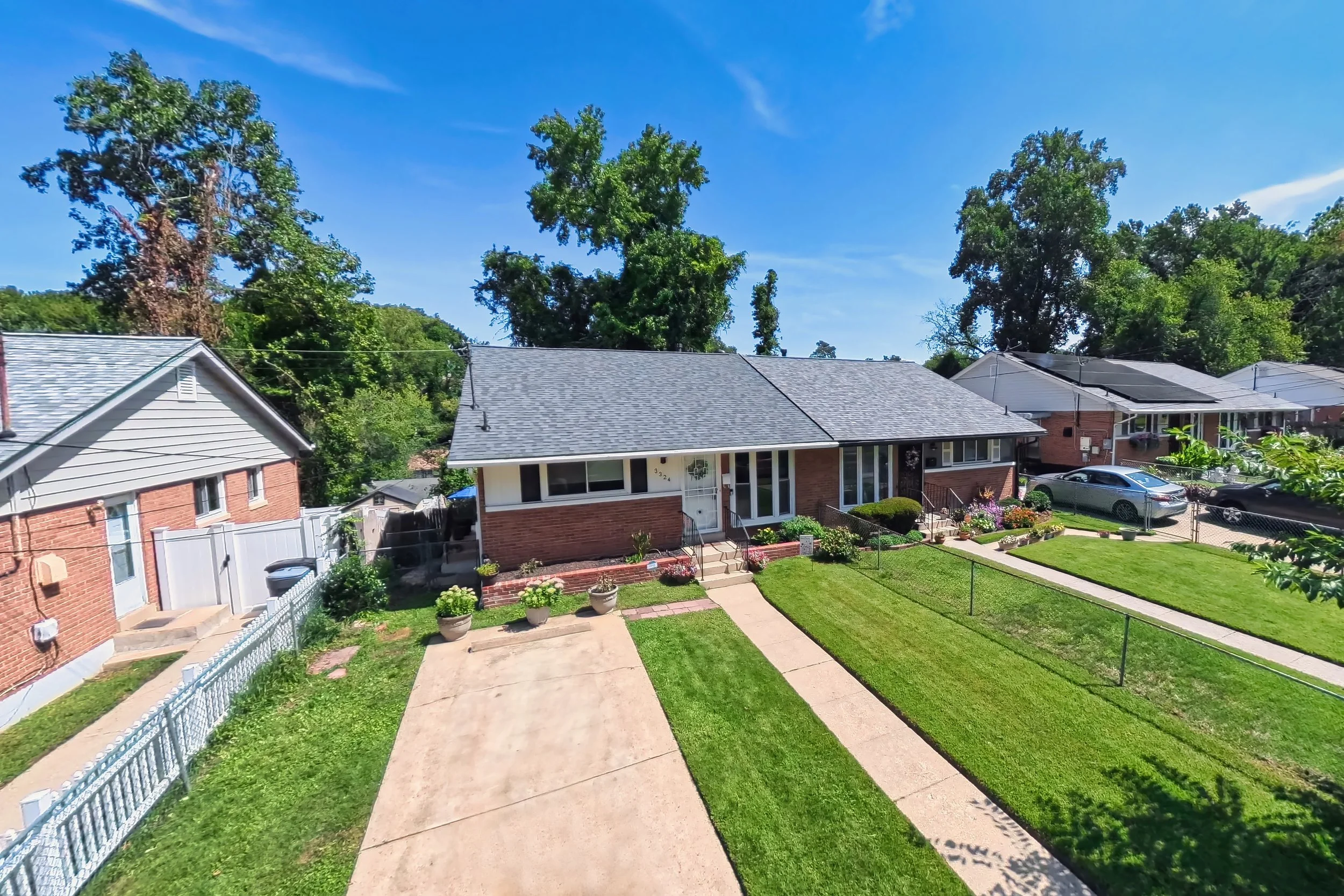
Shot from a mast rather than a drone — an elevated angle without the airspace paperwork.
3D tour — roughly doubles the visit. This is the one that surprises people. A Matterport or Zillow tour is a second, separate capture of the entire property, position by position, and it takes about as long again as the photos did. A 40-photo house that shoots in 45 minutes becomes a 90-minute appointment.
Floor plan scan — 5 to 10 minutes. Quick, and it comes with every package.
Video or a social reel — 30 minutes to an hour. Motion needs its own passes, and the paths through the house get walked more than once.
4. The two things that add a 50% bump to shoot time
Both of these matter more than any add-on, and neither shows up in anyone's estimate.
An occupied home. A house someone still lives in takes roughly half again as long as a vacant one. Every room needs a pass before it can be photographed — the counter cleared, the bathmat straightened, the recycling moved out of frame. If nobody has done that ahead of time, the photographer ends up doing it, working one room ahead of the camera for the length of the shoot. The fix isn't a spotless house; it's twenty minutes of prep in the rooms that matter. Cove Media wrote up the whole method in how to get listing photos when you still live there.
An agent on site. This one is awkward to put in writing, so here it is plainly: an agent at the property adds about 50% as well. Not because anyone is doing anything wrong. It's the conversation, which is welcome and which also stops the shooting. It's being asked to step out of frame, then out of the next one. It's furniture getting adjusted mid-room, and then adjusted back.
If you want to be there, be there — plenty of agents are, and it's your listing. Just block ninety minutes for the house you were quoted an hour on. And if you'd rather not stay, a lockbox and a text when the shoot is finished is the fastest version of this.
The two stack. An occupied house with the agent walking it is a different appointment from the same house empty.
5. Why the last shoot of the day starts before 3:30 PM
Every shoot on the calendar wraps by 3:30, and agents sometimes read that as a limit on light. It isn't. It's a limit on the Beltway.
Travel time in this region roughly doubles after 3:30. A forty-minute run out to a listing becomes eighty, and the same again coming back. A late-afternoon shoot doesn't buy anyone extra daylight; it spends an extra hour and a half sitting on I-495 or the GW Parkway — time that could have gone into the gallery instead.
The light genuinely matters less than agents expect. Because everything is shot HDR and blended afterwards, a room photographed at ten in the morning and the same room at four in the afternoon come out looking the same. Overcast is if anything the easiest condition to shoot a house in — soft, even, no hard shadow thrown across the front elevation. More on why timing matters less than people think.
So the 3:30 wrap costs nothing in image quality. It buys back travel time — and, as the next section explains, it buys the editing hours that get the gallery delivered on schedule.
6. What happens after the shoot
The hour on site is the part agents plan around. It's also the smaller half of the job.
Once the shoot ends, everything gets uploaded, and then the real work starts. Every bracketed sequence gets blended. Verticals get corrected so the walls stand up straight. Colour gets balanced room to room, so the kitchen and the living room look like they belong to the same house. Windows get handled individually. Floor plans get generated from the scan. 3D tours get uploaded and processed. Twilight edits, where they've been ordered, get made here — rather than on a seller's lawn at nightfall.
Editing takes roughly twice as long as the shoot did. An hour on site is two hours at the desk, and that's on a straightforward property.
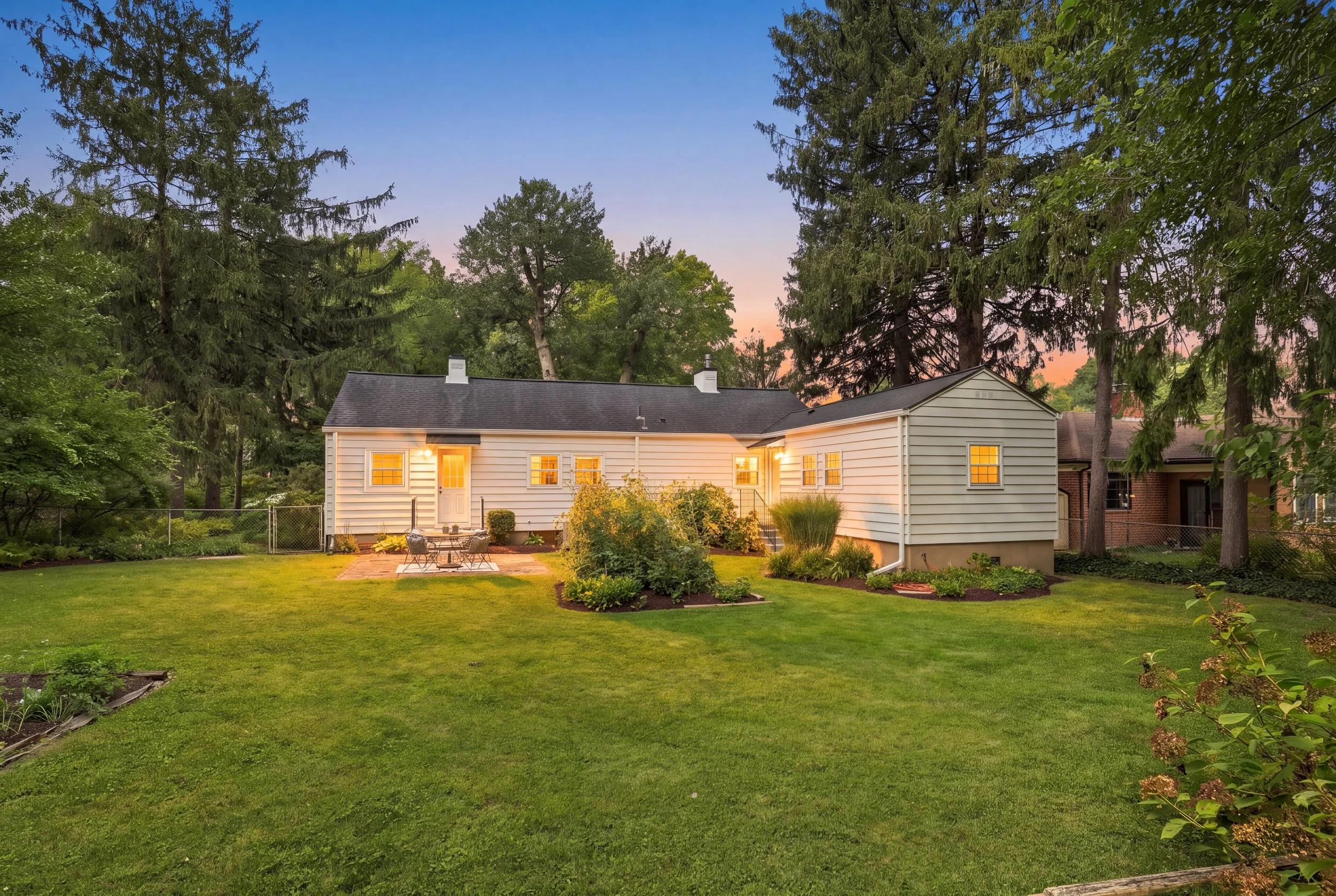
Photographed in daylight and finished as a twilight edit afterwards — one of the things happening in those desk hours.
Which is the other reason the day ends at 3:30. With a 24-hour turnaround, every shoot has to be edited and delivered before the next morning — and the next morning usually has its own shoots in it, so there's no editing to be done during daylight. The evening is when the gallery gets built. A 5 PM shoot doesn't just get home at 7; it pushes four hours of editing into a part of the night where the 24-hour promise starts to wobble. The delivery side is covered in full in the turnaround-time guide.
7. Planning backwards — and leaving a buffer
The clean way to schedule a listing is to start at the end and count back. Photos arrive 24 hours after the shoot, so in theory a Tuesday shoot could go live Wednesday.
Don't schedule it that tight.
Leave several days between the shoot and the go-live date, because the things that go wrong are neither exotic nor rare. The property isn't ready — paint still drying, a room not cleared, landscapers who never came. The weather turns, and an exterior that needed blue sky got grey. Something breaks technically, on either side. Or the gallery arrives and a room wants doing differently.
A buffer turns any of those into a re-shoot rather than a crisis. Without one, the same problem becomes a listing that goes live with a photo nobody is happy with, or a launch date that slips.
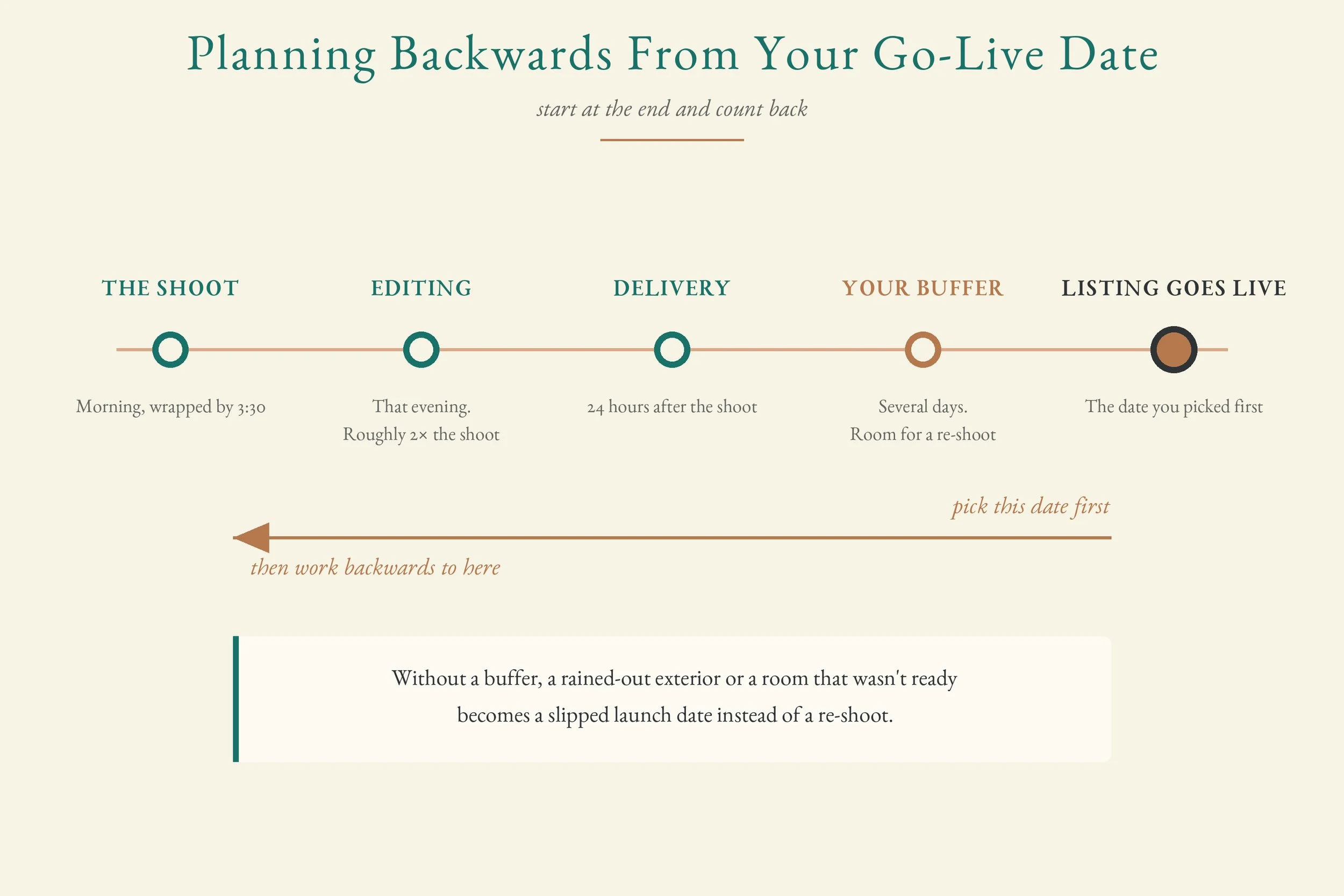
So: pick the go-live date, put the shoot several days ahead of it, and book the morning rather than the afternoon.
That's the whole thing. A condo is half an hour, a mid-sized house is under an hour, a large one is somewhere over it — add half again if it's occupied or the agent is on site — and the photos land the next day.
To see the timings against what each package includes, that's all on the pricing page — or book the shoot and the schedule gets built around your go-live date.