Virtual Staging vs. Traditional Staging in the DC Metro Area: A Cost Comparison (2026)
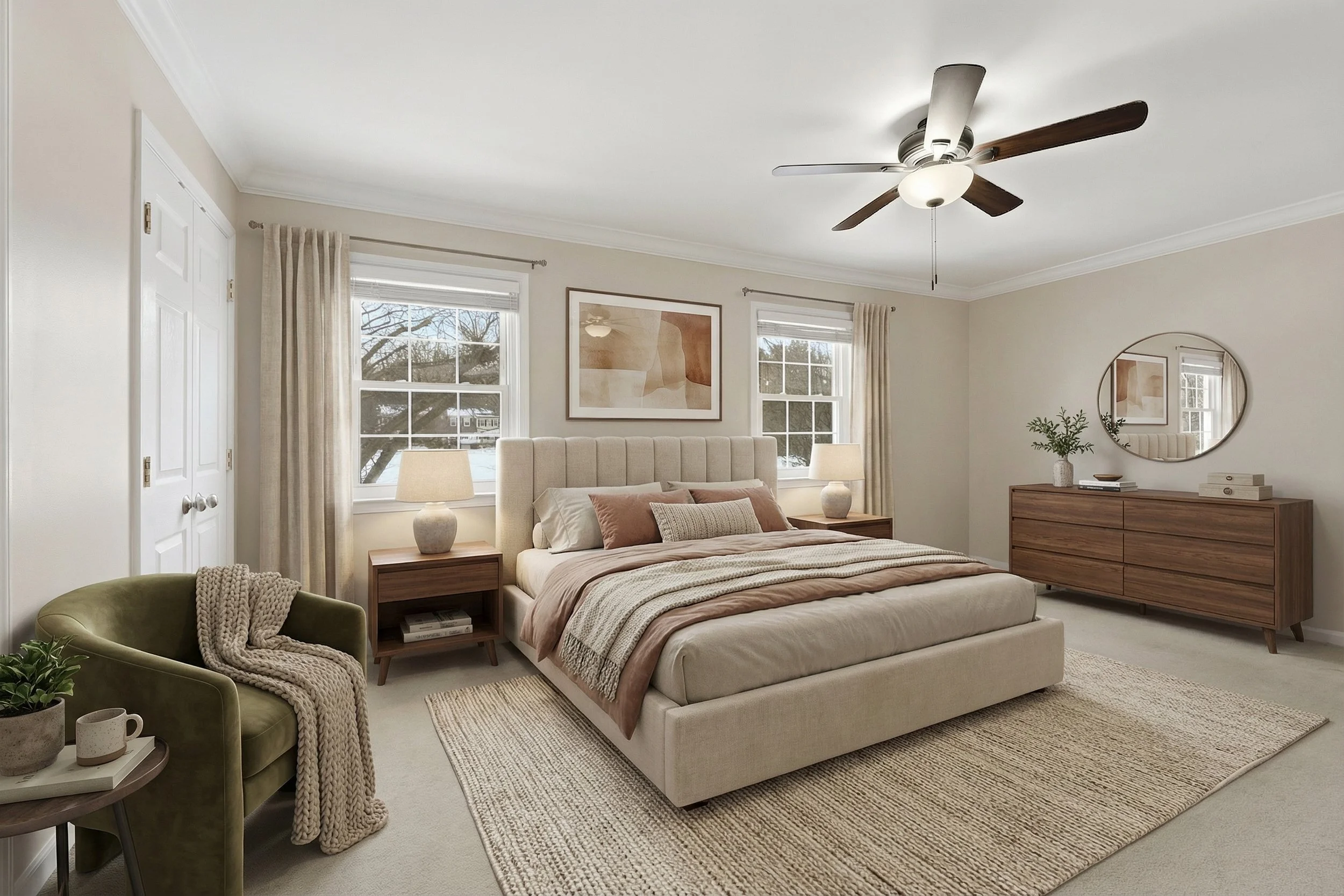
Staging sells homes. That's not a marketing claim — it's consistently backed by data from the National Association of Realtors and agent experience across every price point. The question for DC metro agents isn't whether to stage. It's which kind of staging makes the most sense for each listing.
Traditional physical staging and AI-powered virtual staging both produce results. But they're not interchangeable, and the cost difference between them is substantial. This guide compares what each option actually costs in the Northern Virginia and Maryland market, where each performs best, and how to make the call for your specific listing.
What Is Virtual Staging?
Virtual staging is the process of digitally adding furniture, decor, and design elements to photos of empty or under-furnished rooms. The output is a photorealistic edited image — ready for MLS upload — delivered as a standard JPEG file.
AI-powered virtual staging tools have advanced significantly in recent years. In 2026, well-executed virtual staging is genuinely difficult to distinguish from real staging in listing photos. Shadows are accurate, scale is correct, and design styles range from modern to transitional to traditional — the same styles buyers expect to see in a well-staged DMV listing.
Virtual staging doesn't replace the physical experience of walking through a furnished home. But for online listing photography — where the overwhelming majority of buyer search activity begins — it performs the same job at a fraction of the cost.
Traditional Staging: What It Costs in the DMV
Physical staging in the DC metro area is among the most expensive in the country. Labor, transportation, furniture rental, storage, and insurance all factor into rates that consistently run above national averages.
What agents and sellers can realistically expect to pay in Northern Virginia and Maryland in 2026:
Initial staging fee — setup and first month's rental Condos and small townhomes under 1,500 sq ft: $1,500 – $3,000 Mid-size single-family homes 1,500 – 3,000 sq ft: $2,500 – $5,000 Larger homes and luxury properties over 3,000 sq ft: $4,500 – $10,000+
Monthly continuation fee Most staging companies in the DMV charge 25–35% of the initial fee per month to keep furniture in place. On a $4,000 initial staging, that's $1,000 – $1,400 per month if the home doesn't sell in the first 30 days.
Partial staging — key rooms only Agents who stage only the most-photographed rooms — living room, primary bedroom, kitchen — can expect $800 – $2,000 for 2–3 rooms in the DMV market.
Traditional staging also carries logistical overhead: scheduling the staging company, ensuring access, coordinating timing with the photo shoot, and arranging de-staging once the home goes under contract.
Virtual Staging: What It Costs
Virtual staging pricing varies considerably depending on the provider and quality level. The range in the current market:
Budget or offshore services: $10 – $30 per image Results at this tier are often inconsistent — furniture can look flat, lighting doesn't match, scale is off. Poor virtual staging is obvious to buyers and can undermine a listing's credibility.
Mid-range services: $30 – $75 per image Solid results for most residential listings. Turnaround is typically 24–48 hours.
Premium in-house services: $50 – $100 per image Higher quality control, consistent style across all rooms, faster turnaround. Look for providers who handle editing in-house rather than outsourcing to third-party services.
Typical total cost for a full vacant home: A 3-bedroom home with living room, dining room, primary bedroom, two secondary bedrooms, and a home office — six to seven stageable spaces — runs approximately $180 – $525 at mid-range rates. The equivalent traditional staging in Northern Virginia would cost $3,000 – $6,000 for setup alone, before any monthly rental fees.
When evaluating virtual staging providers, ask specifically whether editing is handled in-house. Providers who outsource often have less quality control, slower turnaround, and inconsistent results across a single property's photos.
See Cove Media's virtual staging service
When Virtual Staging Wins: Vacant Homes and New Construction
This is the strongest use case for virtual staging — and where the financial argument is most clear-cut.
A vacant home feels cold, echoes, and makes rooms look smaller than they actually are. Buyers struggle to understand scale and have difficulty imagining how spaces function. Professional staging — physical or virtual — solves this problem for online listings.
For vacant homes in the DMV, the math is difficult to argue with. A $150 – $300 virtual staging of a 3-bedroom condo or townhome produces listing photos that are indistinguishable from a physically staged property in an MLS gallery. The physical equivalent costs 10–20x more.
Virtual staging images are delivered within 24 hours of the photo shoot and are ready for MLS upload the same day. There's no logistics coordination, no furniture delivery window, no monthly carrying cost if the listing sits longer than expected.
For new construction and builder listings — where multiple units often need to be presented simultaneously — virtual staging is essentially the only economically viable approach at scale. A builder with 12 units to launch can present every floor plan fully staged for the cost of one room of traditional staging.
Key advantages for vacant and new construction listings:
Speed: Virtual staging can be ordered the same day as the photo shoot and delivered the next morning. Traditional staging requires 3–7 days of scheduling and setup.
Flexibility: If buyer feedback suggests a different design direction or a room isn't getting engagement, virtual staging can be revised quickly and inexpensively. Changing a traditional staging requires the stager to return.
No carrying cost risk: Traditional staging accrues monthly rental fees for as long as the home is on market. Virtual staging is a one-time flat cost per image.
View before and after virtual staging examples
When Virtual Staging Works for Rentals and Investment Properties
For rental listings and investor-owned properties, traditional staging economics almost never pencil out. Rental price points in the DMV — even in strong submarkets like Arlington, Bethesda, or Reston — don't justify $2,000 – $4,000 in staging costs. And rental tenants are typically making decisions based on online listings, not in-person staging experiences.
Virtual staging is the practical standard for vacant rental listings in the DC metro area. Furnished photos on Zillow, Apartments.com, and other rental platforms consistently outperform photos of empty units — they generate more inquiries, attract more qualified applicants, and reduce days on market.
For investor-owned flips being listed for resale, the decision depends on price point. At $600K and below in the NoVa market, virtual staging is generally the right call. The ROI on traditional staging at lower price points is difficult to justify when virtual staging delivers comparable listing photos.
For short-term rentals and Airbnb listings, virtual staging is widely used during initial listing setup — it creates the polished online presence that drives bookings before the physical furnishing is complete.
When Traditional Staging Still Makes Sense
Despite virtual staging's advantages in the scenarios above, physical staging retains real value in specific contexts.
Luxury listings where in-person experience is the differentiator. Buyers touring $1.5M homes in McLean, Great Falls, or Potomac are making high-stakes decisions. Walking through a beautifully staged home creates an emotional response that photos cannot fully replicate. At this price point, the staging cost is a smaller percentage of the transaction and the in-person experience matters.
Homes with unusual layouts or scale challenges. Some properties benefit from physical staging that demonstrates how a challenging space — an awkward room shape, an oversized primary suite, a basement with low ceilings — can actually function well. Virtual staging shows the photos; physical staging shows buyers the reality.
Sellers who require it. Some sellers simply feel more comfortable knowing the home is physically staged. In those cases, the cost conversation is worth having, but the seller's comfort with the listing process matters too.
Even in these cases, virtual staging is often used as a supplement — filling in secondary bedrooms, home offices, or bonus rooms that the physical stager didn't address.
Side-by-Side: What to Expect From Each Approach
Cost Traditional staging: $1,500 – $10,000+ upfront, plus 25–35% monthly rental fees Virtual staging: $30 – $100 per image, one-time cost
Turnaround Traditional staging: 3–7 days for scheduling and setup Virtual staging: 24 hours from photo shoot delivery
In-person showing Traditional staging: Buyers experience furnished rooms during showings Virtual staging: Online photos only — rooms are vacant during showings
Logistical overhead Traditional staging: Requires staging company coordination, access scheduling, de-staging Virtual staging: No on-site logistics — all handled in post-production
Flexibility Traditional staging: Fixed design direction; revisions require physical return Virtual staging: Easy to update style or individual rooms based on feedback
Best for Traditional staging: Luxury listings, properties where in-person presentation is a primary differentiator Virtual staging: Vacant homes, new construction, rentals, investment properties, and as a supplement for any rooms not physically staged
The Bottom Line for DC Metro Agents
Virtual staging has crossed a quality threshold where it's a serious tool — not a budget workaround. For the majority of listings in the Northern Virginia and Maryland market, it delivers equivalent online presentation to traditional staging at a fraction of the cost.
The listings where traditional staging still earns its premium are those where the in-person showing experience is a primary factor in the buying decision — typically luxury properties and high-demand homes in competitive submarkets. Even there, virtual staging plays a valuable supplementary role.
For vacant homes, new construction, rentals, and investment properties across the DMV, the financial case for virtual staging is strong and the quality of results in 2026 supports it.
Explore Cove Media's virtual staging options — See our full pricing — Book a shoot
Serving the DC Metro Area
Cove Media provides real estate photography and virtual staging services across:
Northern Virginia: Arlington | Alexandria | McLean | Falls Church | Fairfax | Reston | Herndon | Tysons | Vienna | Oakton | Chantilly | Centreville | Woodbridge | Manassas | Leesburg | Ashburn | Sterling | Great Falls | Annandale | Springfield
Maryland: Bethesda | Rockville | Silver Spring | Chevy Chase | Potomac | Gaithersburg | Germantown | Bowie | College Park | Laurel | Takoma Park | Frederick | Annapolis
Washington DC: All neighborhoods and wards
Cove Media is a full-service real estate photography company serving the Washington DC metro area. Visit cove.media to book your next shoot or explore our services and pricing.