Should You Hire a Real Estate Photographer or Just Use Your Phone in 2026?
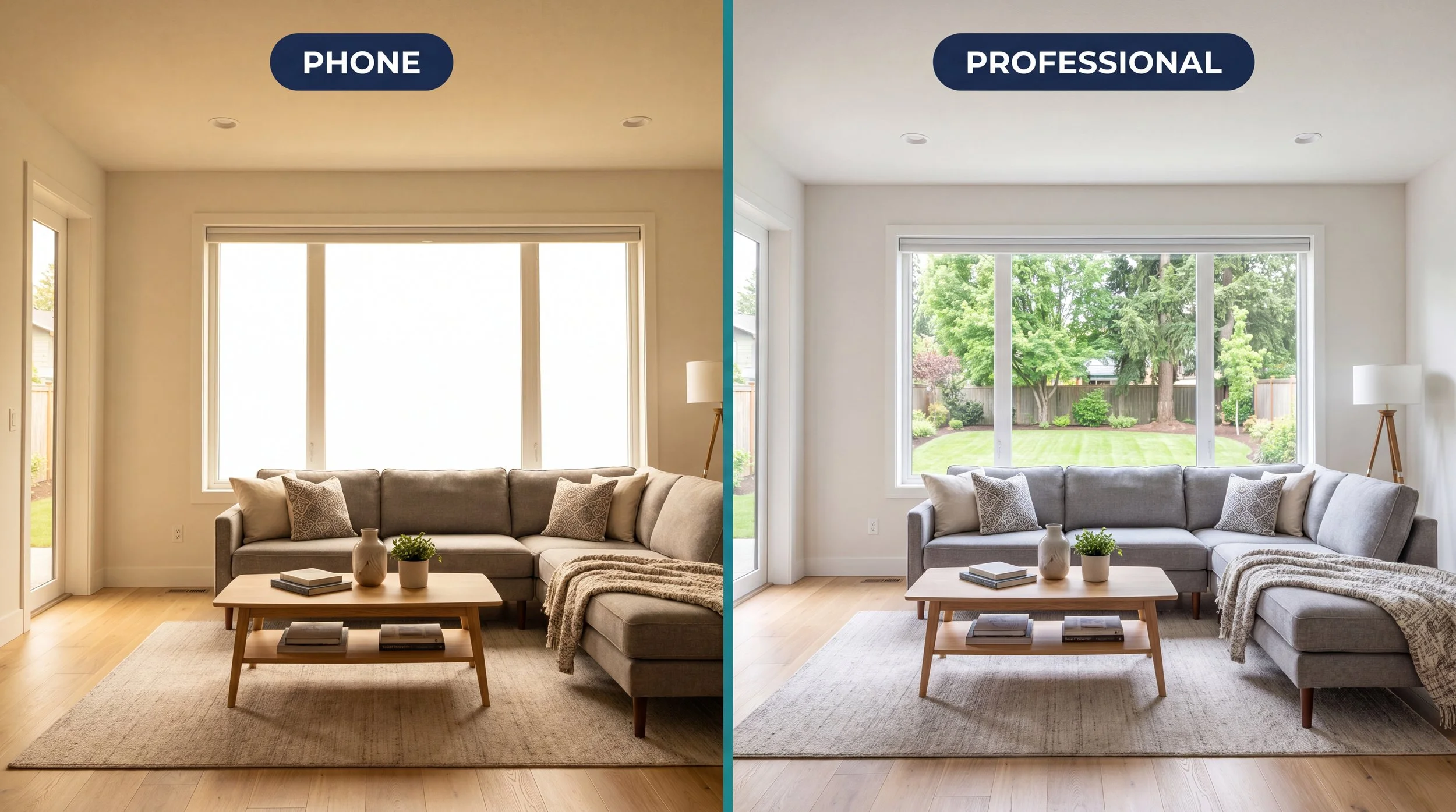
Same room, two tools. The phone (left) loses the window and leans the walls; the professional shot (right) keeps both the view and the room.
Every time Apple ships a new iPhone, the same question makes the rounds at brokerage happy hours: do we still need to pay for a photographer, or is the phone in my pocket finally good enough?
It's a fair question, and the honest answer is more nuanced than either side usually admits. Modern phones take genuinely impressive photos. For a quick preview or your own social feed, they're more than fine. But “good enough for the camera roll” and “good enough for a competitive MLS listing” are two very different bars — and in the 2026 DC metro market, the gap between them shows up directly in days on market and final sale price.
Here's the straight breakdown: what your phone can actually do, what it can't, what the difference costs, and when reaching for the phone is the right call.
First, the honest part — modern phones are genuinely good
Let's give the phone its due. The latest iPhone and Android models have excellent sensors, computational HDR, ultra-wide lenses, and editing built right in. For a lot of everyday photography, they rival cameras that cost ten times as much.
For real estate, a phone is a perfectly reasonable tool when the stakes are low: a quick preview before the pro shoot, behind-the-scenes content for your Instagram, or documenting a property's condition for your own file. If that's the job, save your money.
The problem is that most listings aren't that job. A home you're trying to sell — fast, for top dollar, against well-photographed competition — is exactly where a phone starts to cost you.
The money gap — what listings actually sell for
Start with the number that matters most to your seller: the sale price.
A widely cited Redfin study found that homes priced between $200,000 and $1 million sold for $3,400 to $11,200 more, relative to their list price, when they were photographed with a professional DSLR instead of an amateur point-and-shoot or phone. That's not a rounding error — on a typical DC metro home, it can be a meaningful chunk of your seller's net.
The engagement data points the same direction:
The "Skip" Factor: An overwhelming 73% of buyers report that they completely skip online listings that do not feature professional-grade photos.
Listings with professional photography get about 61% more online views than listings shot with a point-and-shoot or phone (Redfin / Wall Street Journal).
Homes with professional photos have sold roughly 32% faster — one VHT Studios analysis put it at 89 days on market versus 123 (more on the speed angle in our post on whether professional photos help homes sell faster).
Per the National Association of Realtors, 97% of buyers used the internet in their home search, and photos are the single most useful tool in that search, cited by 83% of buyers — ahead of the listing description, virtual tours, and even price estimates.
In a 2026 DC metro market where days on market have stretched (the District's median sat around 55 days in early 2026), the listing photo is doing more work than it has in years. It's the first cut — and a phone photo that loses the click never gets a second chance.

Across multiple independent studies, professional listing photos outperform phone photos on price, views, and speed.
What your phone literally can't do (and why it shows)
This isn't about megapixels. Phones have plenty. The gap is physics and lighting control — and trained buyer eyes notice the result even when they can't name the cause.

It's not megapixels. A full-frame sensor is about twenty times the area of a phone sensor.
Sensor size. A phone's image sensor is roughly twenty times smaller than a full-frame camera's — about 43 square millimeters versus around 864. A bigger sensor gathers far more light, which means cleaner shots in dim rooms, less noise, and far more dynamic range to work with.
Dynamic range and difficult light. This is the classic giveaway. Point a phone at a room with a bright window and you get one of two bad outcomes: the window blows out to solid white (no view) or the room goes dark to save the window. Mixed light makes it worse — a real room combines daylight, warm lamps, and recessed bulbs, each a different color, and a phone leaves the resulting yellow-green color casts in place. A professional brackets several exposures, blends them, adds off-camera flash, and corrects the white balance — so the window shows the backyard, the whole room is bright, and the colors look natural. Phone “auto HDR” tries to do some of this in software, but it's hit-or-miss and often makes the color worse.
A photo that clears those gates looks effortless. A phone photo usually trips at least one of them.
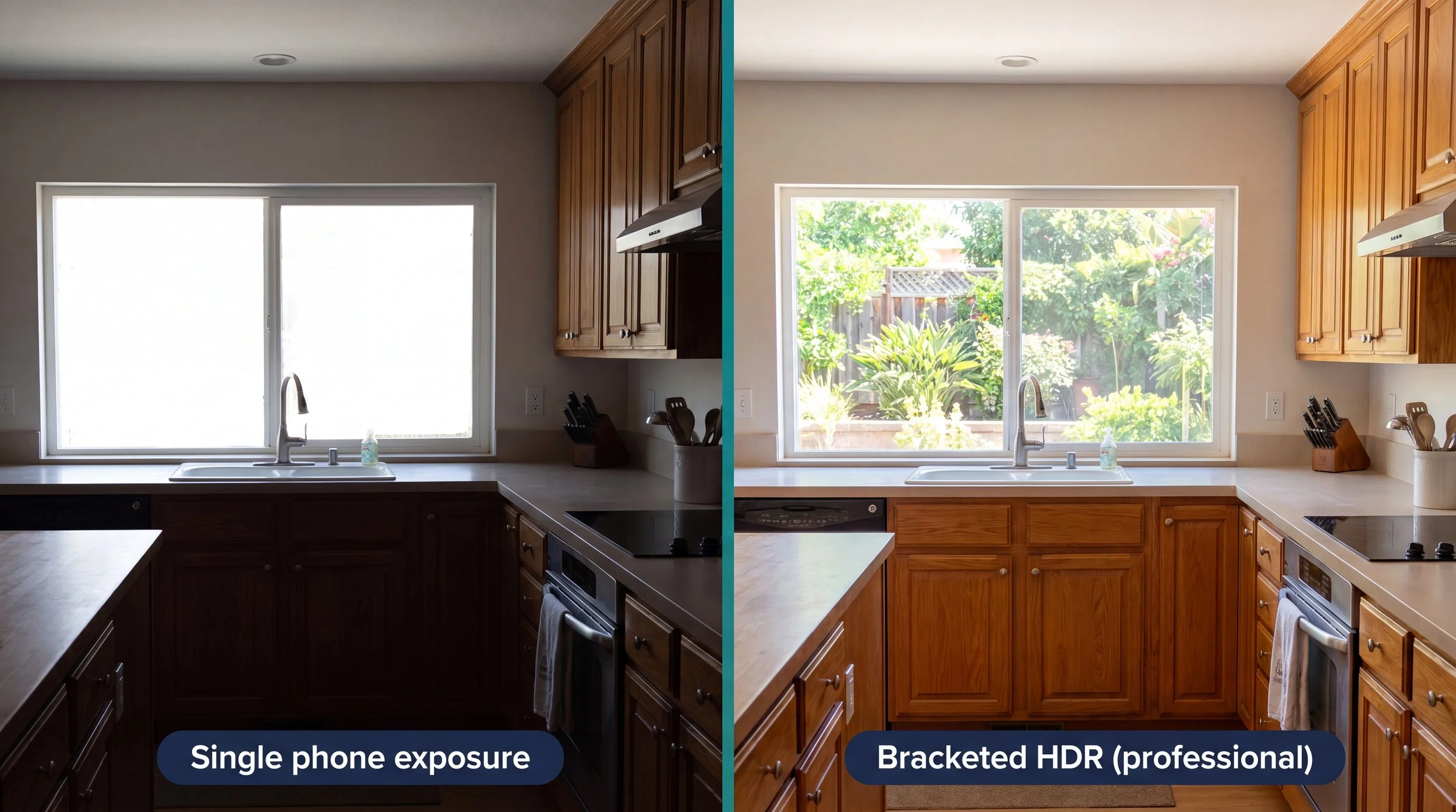
The blown-out window is the most common tell of a phone photo. Bracketed HDR keeps the room and the view.
The trap — it looks fine on your phone screen
Here's what fools a lot of well-meaning agents. On a phone screen — small, bright, glossy, held at arm's length — a so-so photo looks pretty good. So you upload it and move on.
But buyers aren't always looking at it on a phone. They're scanning a grid of thumbnails on a laptop with your listing sitting right next to professionally shot competitors. There, the same photo looks dim, tilted, or flat by comparison. Buyers give each listing about two seconds before deciding to click in or scroll past — and once they scroll past, they almost never come back.
When the phone is actually fine (and when it costs you)
So this isn't “always hire a pro, no exceptions.” It's about matching the tool to the stakes.
A phone is a reasonable choice for:
Scouting or preview shots before the real shoot, for your own planning
Behind-the-scenes content for your own social feed
Documenting a property's condition for your records
Off-market or pocket listings shared privately with a small, known group
Hire a professional for:
Any on-market sale listing — especially the competitive $400K–$1M+ range that is the core of the DC metro market
Luxury listings ($1.5M+), where buyers expect production quality and the perceived-value gap is widest
Condos and townhomes, where you have to convey light and layout through photos because square footage is tight
Homes with specific selling features — a renovated kitchen, a finished basement, water views, a custom backyard — that phone photos routinely flatten or miss
Listings in slower micro-markets (Washington D.C. proper especially), where every advantage counts
Rental and investment listings, too. It's a myth that phone photos are “good enough” for a rental — a weak gallery tends to leave a rental sitting on the market longer, not move it faster.
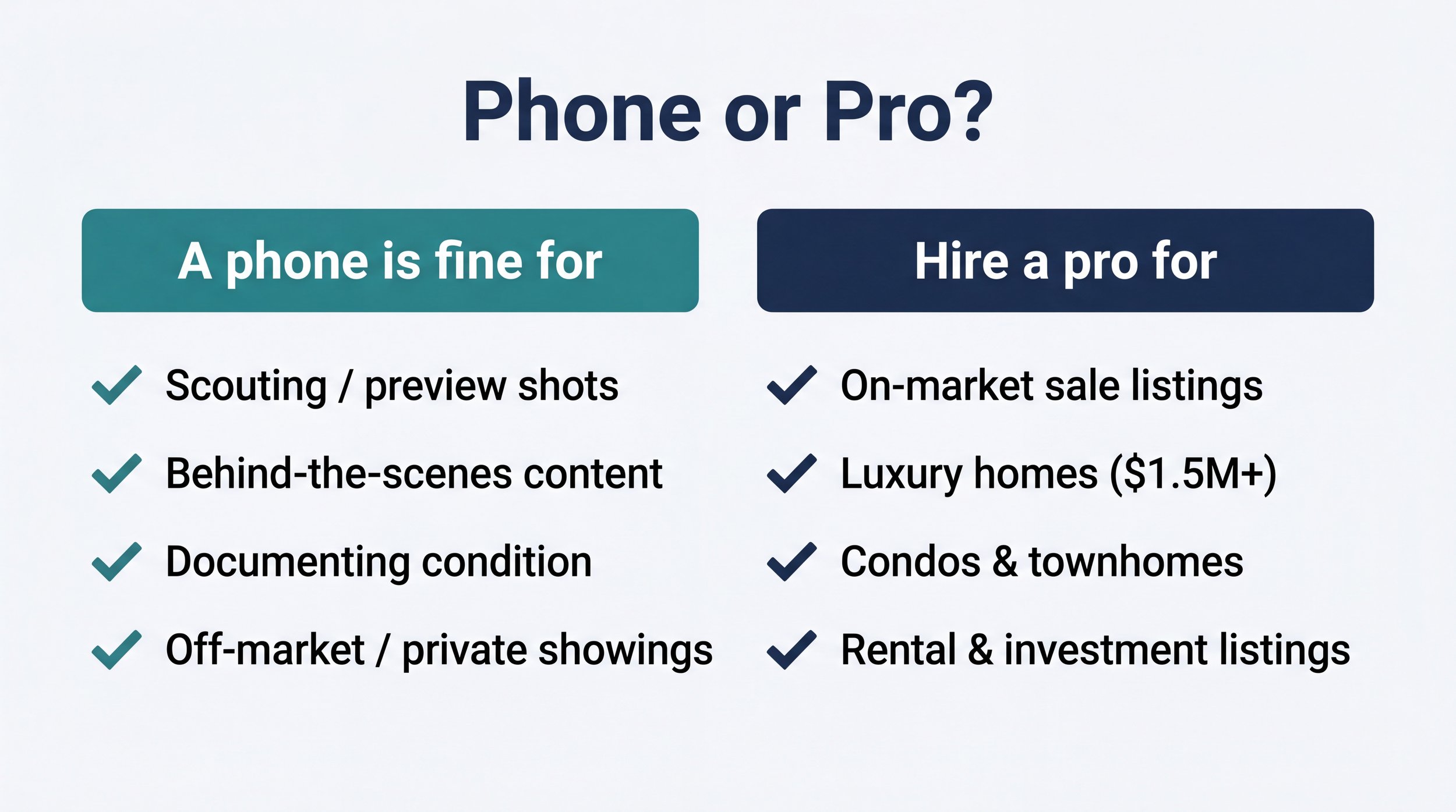
Match the tool to the stakes: a phone for low-stakes shots, a pro for any listing that has to compete.
The cost math (it's not close)
The real price of phone photos isn't the zero dollars you spend — it's what they cost you on the back end.
A professional shoot for a standard DC metro home runs roughly $200–$500. Set that against a Redfin-documented $3,400–$11,200 swing in sale price and the extra weeks a weaker-looking listing tends to sit. One saved week of carrying cost — mortgage interest, taxes, utilities, HOA — on a $700K home usually covers the shoot several times over.
Put bluntly: phone photos are the most expensive “free” you can put on a listing.
Cove's approach
HDR baseline on every shoot. Bracketed exposures, blended in post — no blown windows, no dark interiors.
Proper lenses and line correction. Straight verticals and honest proportions — rooms that look the way they actually do, edited to a consistent standard across the whole set.
24-hour delivery in Bright MLS-ready output. Correct resolution and aspect ratio, ready to upload — your listing can go live the day after the shoot.
FAA Part 107 drone coverage with LAANC authorization across Maryland and Northern Virginia, where aerials add to the listing.
Free weather rescheduling. A bad-light shoot doesn't help anyone.
Local market knowledge. Cove shoots DC metro homes every week and knows what photographs well in this specific market.
Book your listing shoot
Your phone is a great camera. It's just not the right tool for a competitive MLS listing in a market where buyers decide in two seconds. When the goal is the fastest sale at the best price, the photography is a leverage point — not a place to cut.
Book at cove.media. Full pricing — including HDR, drone, twilight, Matterport, and video add-ons — is at cove.media/pricing.
Service area
Cove Media provides real estate photography across the Washington DC metropolitan area, including the District of Columbia, Northern Virginia (Arlington, Alexandria, Fairfax, Loudoun, Prince William) and Maryland (Montgomery, Prince George's, Howard, Anne Arundel, Frederick). All drone work is performed under FAA Part 107 certification with LAANC authorization where applicable.